Colour & Palette
Negozio Olivetti, Venice: Reading Carlo Scarpa’s Glass Floor
Inside a Venetian showroom where a change of colour marks a change of place.
At the Negozio Olivetti, Carlo Scarpa used coloured glass mosaics to distinguish areas of a narrow showroom beneath the Procuratie Vecchie in Venice.
At the Negozio Olivetti in Venice, glass can tell you where you are. Red, blue and gold mosaics mark out different parts of the shop. Carlo Scarpa gave a room built to display office machines a floor worth looking at even after the last typewriter has gone.
In Short
- Adriano Olivetti commissioned Scarpa to design the showroom under the Procuratie Vecchie in Piazza San Marco.
- The long, narrow site extends over two floors. Changes of material help the eye read it in smaller pieces.
- The staircase and the sculpture plinth offer two ways of looking at stone. One breaks it into separate steps. The other lets water run over its face.
Picture Notes
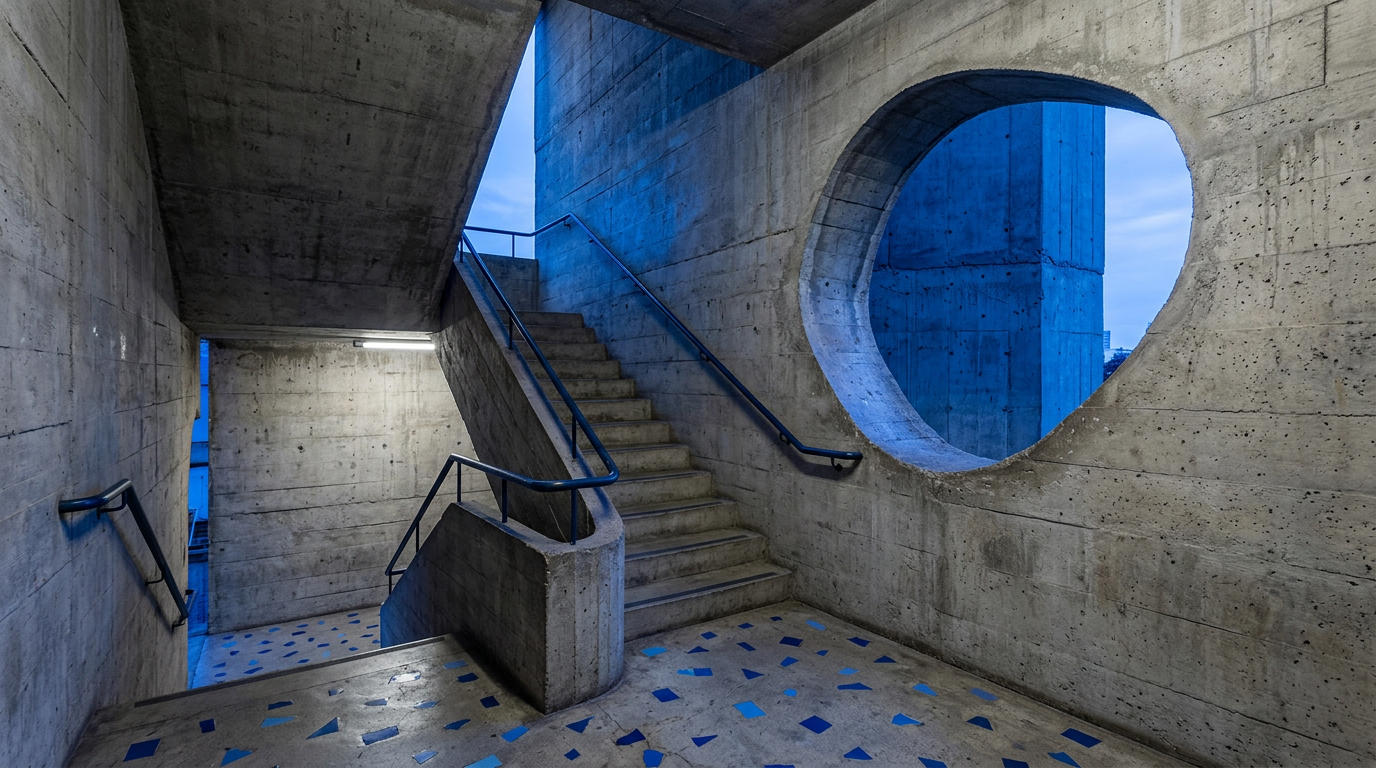
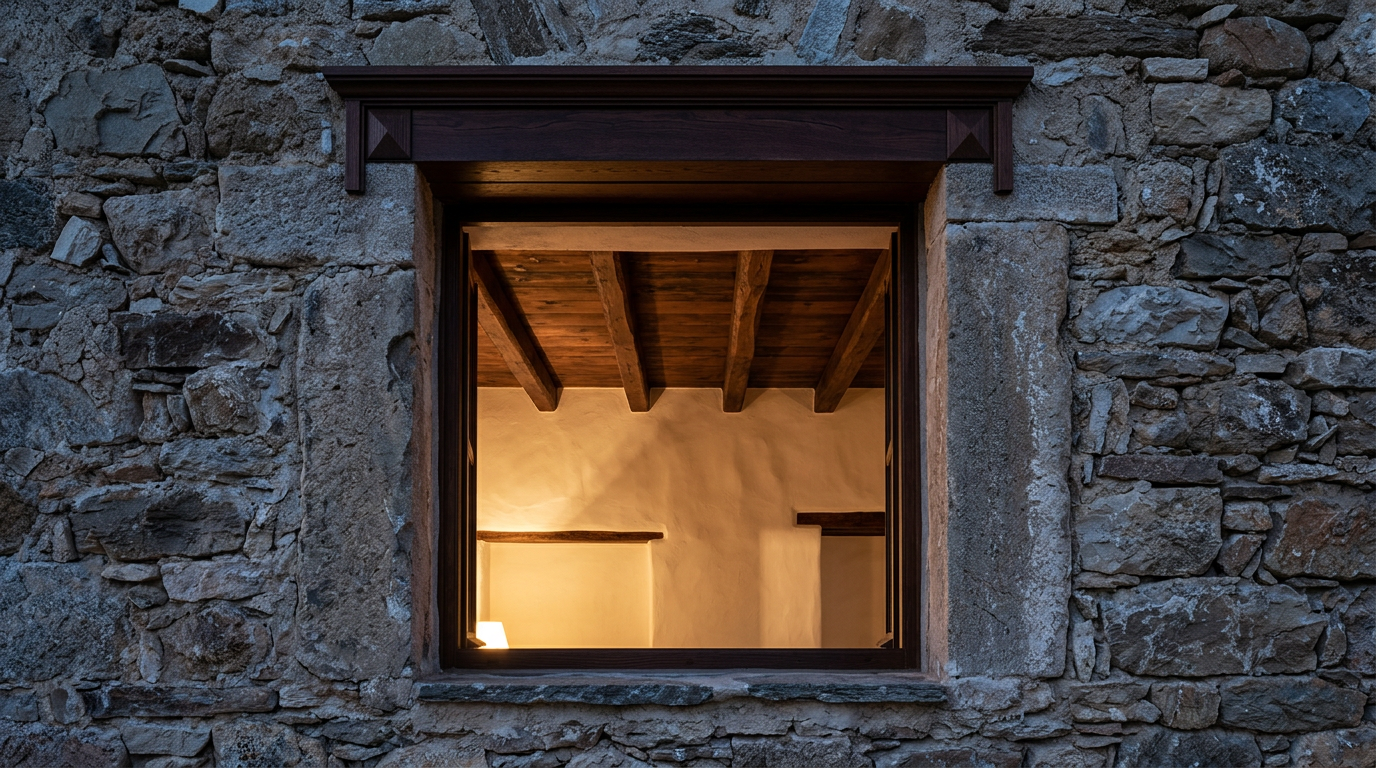
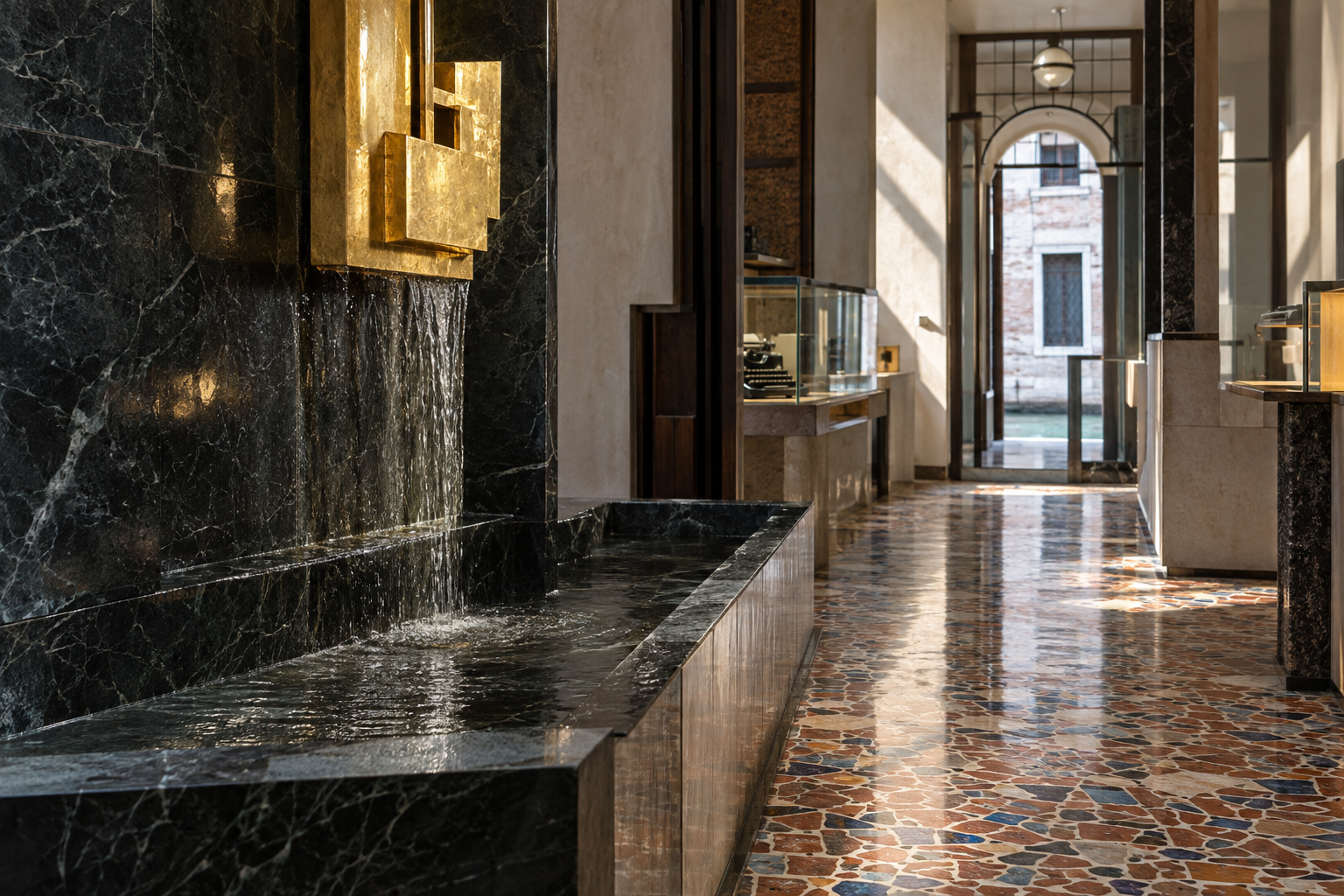
These notes describe the AI illustration shown with this article, not photographs of the real place.
1. Lead illustration: Interior volume — AI illustration — a view into the interior volume and its light, showing an inhabited interior with a warm palette.
A shop for looking closely
The commission came in 1957. Olivetti wanted a place in St Mark’s Square to show its typewriters and calculating machines. The site measured roughly twenty metres by four. Draw those proportions on a sheet of paper and the problem comes into focus. A desk placed sideways interrupts the long view. Objects lined along one side can turn a display into a queue.
Imagine setting a typewriter in this room. It asks to be seen from the distance of a pair of hands. The square outside belongs to quite another scale. The pleasure of the shop, for me, lies in the attention it gives to the short distance between the two. A visitor can look down at the edge of a key, across the mosaic at their feet, then up along a flight of stone.
Colour as a way of finding your place
The description published by Generali identifies three colours in the glass floor. What interests me is how little drawing is needed for a colour change to describe a place. In a plan, the temptation is to put a line around each display. Underfoot, two adjacent fields can do the same work more quietly. You can stand with a foot on each side of the boundary.
Consider the size of an individual piece. A red rectangle of glass is small enough to pick out from its neighbours. Take a few steps back and it becomes part of a larger patch. That gives the eye two things to do in the same area of floor. A uniform sheet of colour would make for a very different shop.
Reading stone and water
At the stair, the stone has a readable thickness. At the plinth, what you see first can be the reflection. Beneath Viani’s sculpture, water covers Belgian black marble. In a drawing of the detail, it would take two lines drawn almost together to represent those two surfaces. In a picture, it can be difficult to tell which one you are looking at.
There is a practical lesson here for anyone drawing a small interior. Choose one material and ask how many different edges it can have. A stair tread ends in air. A plinth ends at a lip. A sign meets a wall. A catalogue of stone samples tells us considerably less about those experiences than a section through each edge.
What the machines bring back
FAI records that the shop closed in 1997 and sold tourist goods for a time. In 2009 Generali announced an agreement with FAI. In its 2011 account, FAI describes the return of historic Olivetti machines to the display, including a Lettera 22.
An office machine gives a room like this a measure of its own. The keys suggest a hand and the carriage suggests the width of a page. Set that familiar object against a dark plinth or the edge of a slab and the scale of each becomes easier to judge. The case for seeing the machines here is architectural as well as historical.
ARCHITECTT Note
The view I would draw first is the meeting of floor and stair. A single glass piece at the foot of the drawing gives the eye a starting point from which to read the whole flight. In the ARCHITECTT studio, try drawing the same threshold at the scale of a room and again at the scale of a hand.
Closing
A good showroom offers a reason to look up after examining the thing on display. Here, the movement can also go the other way. Look down from the suspended stairs and there is an entire field of glass to explore, one small rectangle at a time.
FAQ
Where is the Negozio Olivetti?
Under the Procuratie Vecchie arcade in Piazza San Marco, Venice.
What did the showroom display?
Olivetti typewriters and calculating machines. FAI describes the later donation of historic machines, including a Lettera 22.
What stone did Scarpa use for the stairs?
Aurisina marble. The owner’s historical account describes the treads as suspended slabs.
Why does the floor change colour?
Generali’s account identifies different areas of the showroom by their red, blue or gold glass mosaics.
In Short
Look down to see how Scarpa divided an unusually narrow room into places for display.
Key takeaways
- —Red, blue and gold glass mosaics distinguish areas of the floor.
- —Aurisina marble forms the staircase. Black Belgian marble forms the water-covered plinth.
- —The building originally displayed Olivetti typewriters and calculating machines.
Sources
- The commission, dimensions, stone, glass, water, woodwork and 2009 agreement are documented in the owner’s historical account.https://www.generali.com/doc/jcr%3A2ba36670-a1c0-4413-a463-84abb310a6b2/lang%3Aen/fai_E.pdf
- The custodian records the original display use, the closure in 1997 and the donation of historic machines, including a Lettera 22.https://fondoambiente.it/news/negozio-olivetti
Topics
Explore related reading
Continue reading