
Stories of Place
Sir John Soane: A London Penthouse Reimagined for Air Quality
The Georgian architect’s material honesty finds contemporary resonance in discussions of indoor air purity.
Sir John Soane's Georgian architectural principles, particularly his use of natural materials like lime render and fresco, offer a model for achieving superior indoor air quality by minimizing volatile organic compounds (VOCs) and promoting building breathability.
Sir John Soane’s architectural philosophy, rooted in the Georgian era, offered a rigorous approach to material use that inadvertently addresses modern concerns about indoor air quality and off-gassing. While never explicitly concerned with volatile organic compounds (VOCs), Soane’s preference for natural, durable finishes like lime render and fresco, applied with minimal adulteration, established a precedent for material honesty. This approach stands in contrast to many contemporary practices involving synthetic materials, highlighting a timeless wisdom in his construction methods for a proposed London penthouse reimagined with these principles.
In Short
- Soane’s Georgian material choices inherently reduced VOCs and improved indoor air quality.
- Lime render provides natural breathability and moisture regulation in building envelopes.
- Fresco techniques employed mineral pigments and water, avoiding synthetic binders.
- A focus on durable, honest materials extends building lifecycles and minimizes replacements.
Picture Notes
1. Precision Timber Joint — Visible finger joints in an engineered oak CLT panel demonstrate the structural and aesthetic integrity. The connection is unadorned, allowing the wood grain to express itself. 2. Lime Render Texture — A close-up of a meticulously applied lime render surface, showcasing its subtle, matte finish and slight variations. The natural aggregate provides tactile depth. 3. Fresco Detail — A segment of a fresco painting reveals the fusion of mineral pigments with wet lime plaster. The color penetration is deep and integral to the wall surface, with no surface film. 4. Glulam Edge Reveal — The layered edge of a Douglas-fir glulam beam is exposed where it meets a plaster wall. The lamination lines are precise, showing the engineered strength of the timber. 5. Charred Cedar Grain — A charred cedar panel, revealing the distinct grain and textural variation against an adjacent smooth surface. The process enhances durability without synthetic coatings.
Georgian Principles and Contemporary Health
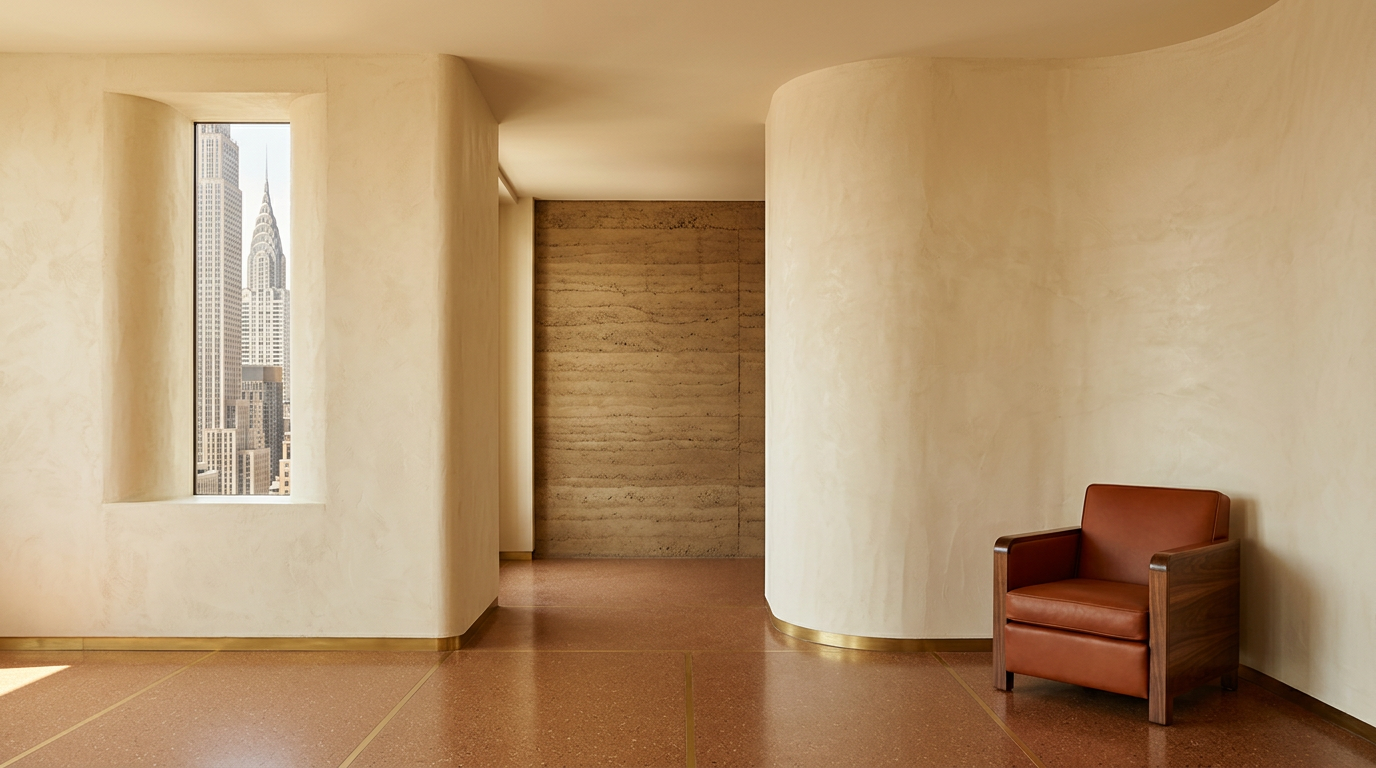
Georgian architecture, particularly as practiced by figures like Sir John Soane, emphasized materials not only for their aesthetic qualities but also for their inherent structural integrity and longevity. In an era predating modern chemistry, building components were largely derived from natural sources: stone, timber, lime, and mineral pigments. Soane’s extensive use of lime-based plasters and renders, alongside traditional fresco techniques, aligns with contemporary calls for healthier indoor environments. These materials, by their very nature, are low in VOCs. Lime, derived from limestone, offers breathability, allowing moisture vapor to pass through walls, which can prevent the buildup of mold and mildew, common contributors to poor indoor air quality.
Beyond functionality, Soane's aesthetic often celebrated the unadorned surface. His work at the Bank of England, for instance, used robust brick and stone, rendered with simple, mineral-based finishes. This material honesty ensured that the building itself did not off-gas harmful chemicals into its interiors, a concern absent in his time but critically relevant today. Modern construction, by contrast, frequently incorporates adhesives, sealants, paints, and composite wood products that can release VOCs over extended periods, impacting occupant health. A penthouse design informed by Soane's material palette would prioritize large format engineered oak CLT for structural elements, paired with lime render walls and ceilings, ensuring structural integrity and a healthier interior atmosphere.
The Craft of Lime and Fresco
Lime render and fresco painting are ancient techniques that Soane understood and employed for both durability and aesthetic effect. Lime render, a mixture of lime, sand, and water, cures slowly by carbonation, forming a highly durable and porous surface. This porosity contributes significantly to regulating indoor humidity and reducing condensation, directly influencing air quality. Modern synthetic renders, while often faster to apply, lack this natural breathability and can introduce petrochemicals into the living environment.
Fresco, meaning
In Short
Sir John Soane's Georgian material honesty offers a timeless approach to healthy indoor air quality, applicable to modern urban dwellings.
Key takeaways
- —Sir John Soane’s Georgian material choices, such as lime render and fresco, offer natural solutions for reducing VOCs and improving indoor air quality.
- —Contemporary design can integrate Soane’s principles by using engineered timber, lime-based finishes, and mineral paints to create healthier urban living spaces.
- —Material honesty is not only an aesthetic choice but also a functional one, contributing to building longevity and occupant well-being.
- —The breathability of traditional materials helps regulate indoor humidity and mitigate mold growth, essential for a healthy environment.
- —Designing with a focus on material integrity can minimize off-gassing and promote a more sustainable building lifecycle.
Frequently asked
How did Georgian architecture address indoor air quality?
+
Georgian architecture, through its reliance on natural materials like lime, timber, and mineral pigments, inherently produced healthier indoor environments. These materials typically have low volatile organic compound (VOC) emissions and promote natural breathability within structures, regulating humidity and reducing the presence of mold and mildew.
What are the benefits of lime render for air quality?
+
Lime render is breathable, allowing moisture vapor to pass through walls, which helps regulate indoor humidity and prevents condensation. This natural porosity reduces the risk of mold and mildew growth. As a mineral-based material, it emits minimal to no VOCs, contributing to superior indoor air quality.
How can historical building practices inform modern healthy building design?
+
Historical practices, exemplified by Sir John Soane’s work, highlight the benefits of material honesty and natural components. By prioritizing durable, non-toxic materials such as engineered timber, lime renders, and mineral paints, modern design can minimize VOCs, improve indoor air quality, and enhance building longevity, reducing the need for material replacement.
What is the role of material honesty in architecture?
+
Material honesty advocates for using and exposing materials in their natural state, without excessive disguise or synthetic coatings. This approach not only celebrates the inherent beauty and structural properties of materials but also contributes to healthier indoor environments by reducing the reliance on chemical-laden finishes that can off-gas harmful compounds.
Who was Sir John Soane?
+
Sir John Soane (1753–1837) was a prominent English architect of the Georgian era, known for his innovative use of space, natural light, and a disciplined approach to classical forms. His work, including the Bank of England and his own house-museum, emphasized material integrity and sophisticated detailing.
What are VOCs and how do they impact indoor air quality?
+
Volatile Organic Compounds (VOCs) are gases emitted from certain solids or liquids, including many common building materials like paints, adhesives, and synthetic furnishings. Short-term exposure can cause headaches and irritation, while long-term exposure is linked to more serious health issues, making their reduction critical for indoor air quality.
Sources
- Sir John Soane (1753–1837) was a prominent English architect of the Georgian era, known for his innovative use of space, natural light, and a disciplined approach to classical forms.https://en.wikipedia.org/wiki/John_Soane
- His work at the Bank of England, for instance, used robust brick and stone, rendered with simple, mineral-based finishes.https://www.soane.org/house-museum/bank-england
- Fresco, meaning 'fresh' in Italian, involves applying pigments mixed with water directly onto wet lime plaster.https://www.metmuseum.org/toah/hd/fres/hd_fres.htm
- CLT panels, typically made from three, five, or seven layers of timber boards, glued perpendicularly to one another, offer structural stability and thermal performance.https://www.thinkwood.com/mass-timber/products/clt
Topics
Referenced in this piece
Continue reading