
Architect Minds
Copenhagen’s Black Earth: Mughal Tiles and Rammed Earth Colour
A research centre in Copenhagen uses black glazed ceramic tiles and pigmented rammed earth to define its architectural identity, blending traditional craft with modern material science.
The Copenhagen research centre uses black glazed ceramic tiles and pigmented rammed earth for its facade, integrating traditional craft with modern material science to create a distinct architectural identity grounded in its site and climate.
The precise application of black glazed ceramic tiles and carefully pigmented rammed earth facades in a Copenhagen research centre demonstrates how material choice dictates architectural expression. This approach transcends mere surface decoration, integrating the building into its site while establishing a distinct material language.
In Short
- A research centre in Copenhagen employs black glazed ceramic tiles and pigmented rammed earth.
- The project uses colour as a fundamental architectural decision, not an afterthought.
- Traditional ceramic techniques inform a contemporary rainscreen application.
- Rammed earth with integrated pigment creates a dark, monolithic presence.
Picture Notes
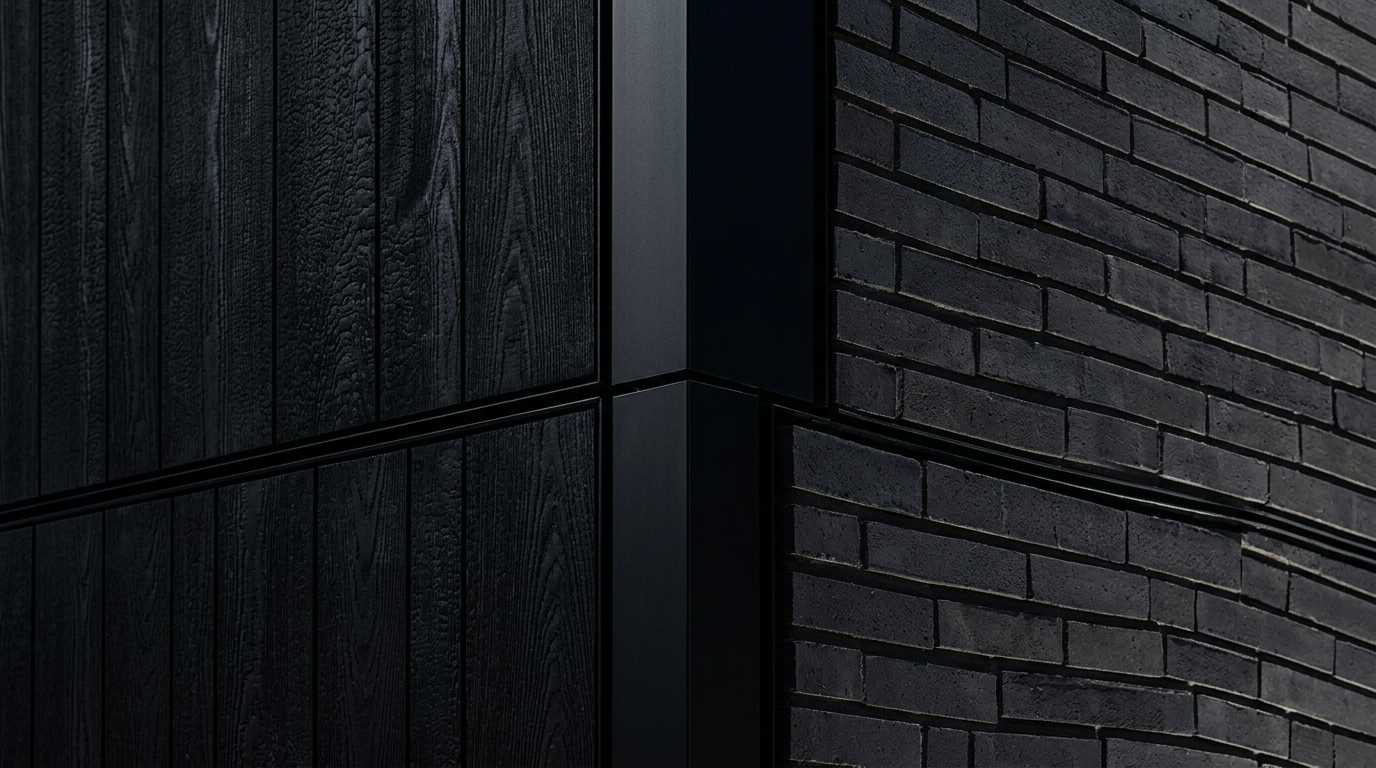
1. Glazed tile edge — A precisely cut edge of a black ceramic tile reveals the dark body beneath its reflective glaze. The subtle undulation catches ambient light, highlighting textural variations. 2. Rammed earth striation — Fine horizontal lines mark the compaction layers of the black-pigmented rammed earth, evidencing its meticulous construction. The surface maintains a matte, earthy texture. 3. Rainscreen joint — A narrow, precise shadow gap separates individual black glazed ceramic rainscreen panels. This detail allows for movement and drainage, ensuring long-term facade integrity. 4. Basalt aggregate — Dark, angular basalt aggregate is visible within the rammed earth matrix, contributing to its deep black hue and structural stability. Its varied sizes add visual depth. 5. Recessed glazing frame — A thin, blackened steel frame holds the glass within a deeply recessed opening in the rammed earth wall. This creates a sharp, shadowed aperture against the dense facade.
Pigmented Earth and Ceramic Craft in Copenhagen
The research centre in Copenhagen represents a contemporary interpretation of material use, integrating a craft-based approach with advanced construction techniques. The building’s primary facade elements consist of locally sourced earth, densely compacted into monolithic walls, and an external rainscreen of black glazed ceramic tiles. This material strategy responds to the local climate while offering a visual dialogue with historical craft traditions, specifically the intricate tilework found in Mughal architecture. The decision to infuse the rammed earth with black pigment directly at the mixing stage ensures a uniform, deep colour saturation that resists fading, a technique honed through extensive material science research at the Technical University of Denmark (DTU).
The historical influence of Mughal tilework, known for its complex geometries and vibrant, often dark, glazes, is evident in the building's ceramic rainscreen. While the patterns are simplified for a modern context, the focus remains on the optical depth and reflective quality of the glaze. Each ceramic tile, measuring 600 mm by 300 mm, is custom-fired to achieve a specific sheen and a consistent, near-black finish. This provides a dynamic surface that shifts in appearance under varying light conditions, from the sharp sun of a Danish summer day to the diffused light of winter. The rainscreen functions as both an aesthetic skin and a protective layer, managing water runoff and contributing to the building’s thermal performance. The tiles are installed on a precise aluminium subframe, allowing for ventilation and moisture management behind the facade.
Colour as Architectural Decision: Beyond Ornamentation
The deliberate choice of a deep black palette for the entire structure—from the rammed earth to the glazed ceramic tiles and blackened steel fenestration—is a fundamental architectural decision for the Copenhagen research centre. This is not a decorative overlay, but an intrinsic aspect of the building’s identity, influencing its perceived mass, thermal performance, and relationship to its surroundings. Architects at Cobe, the firm responsible for the project, articulated this approach, stating that the darkness serves to ground the building, making it a contemplative object within the campus landscape. The black colour absorbs solar radiation, which is then managed by the building's high thermal mass and advanced ventilation systems, contributing to its energy efficiency targets.
The pigmented rammed earth walls, reaching thicknesses of up to 500 mm, provide excellent thermal insulation and acoustic dampening. The use of black pigment, primarily iron oxide, was chosen for its stability and minimal environmental impact. This contrasts with the highly reflective quality of the black ceramic glaze, which, despite its dark hue, refracts light, preventing the facade from appearing monolithic or oppressive. The interplay between the matte, absorptive quality of the earth and the glossy, reflective quality of the tile creates a nuanced material experience. This nuanced black palette ensures the building retains its sculptural quality without becoming a dark void.
The Craft of Ceramic Rainscreens
The application of the glazed ceramic rainscreen represents a modern continuation of the intricate craft of tile making. Unlike traditional Mughal tilework, which often involved direct mortar application, this contemporary system utilizes a ventilated facade assembly. The individual black ceramic panels are mechanically fastened to a rail system, allowing for precise alignment and independent replacement. This system ensures durability and maintainability, crucial for a public research institution. The tiles are manufactured by Strøjer Tegl, a Danish company with a long history in ceramic production, adapting their traditional methods to produce the specialized glazed finish required for this project.
The process involves firing the ceramic at temperatures exceeding 1200°C, which vitrifies the clay body and sets the glaze permanently. The deep black glaze was developed to mimic the richness found in historical dark-glazed ceramics, while meeting contemporary performance standards for weather resistance and UV stability. Each tile undergoes rigorous quality control to ensure uniform colour, minimal warping, and precise dimensions. This attention to detail underscores the project’s commitment to craft, even within an industrial production context. The rainscreen's modularity also allows for repair without disturbing large sections of the facade.
ARCHITECTT Note
We observe how a singular focus on material and colour can define a building's presence. The Copenhagen research centre demonstrates that a restricted palette, when thoughtfully applied, offers a depth and sophistication often lost in more varied schemes. It is a lesson in restraint, where black is not an absence of colour, but a considered architectural force.
Closing
The Copenhagen research centre stands as an exemplar of how materiality and a conscious colour strategy can merge into a cohesive architectural statement. The dialogue between the ancient technique of rammed earth and the refined craft of glazed ceramics, all unified by a deep black palette, provides the building with both rootedness and a contemporary edge. This project suggests that exploring material science in conjunction with historical craft offers a viable path for creating structures that are both performant and aesthetically compelling, reflecting a profound understanding of site and purpose.
FAQ
What is rammed earth and how is it used in the research centre?
Rammed earth is a building technique using natural raw materials, primarily soil, compressed into solid layers to form walls. In this Copenhagen research centre, it is used for the primary structural walls, pigmented black for aesthetic and thermal reasons.
Why were black glazed ceramic tiles chosen for the facade?
Black glazed ceramic tiles were selected for their aesthetic depth, reflective qualities, and durability. They create a dynamic rainscreen facade that protects the building and contributes to its overall dark, cohesive architectural language, drawing inspiration from historical Mughal tilework.
How does the colour black function as an architectural decision here?
The use of black is central to the building's identity, influencing its perceived mass, energy performance, and contextual integration. It is an intentional design choice to ground the building and manage solar absorption, rather than mere decoration.
What is a rainscreen facade system?
A rainscreen facade is an outer layer of cladding that stands off from a building's main structure, creating a cavity behind it. This system protects against weather, allows for ventilation, and improves thermal performance, as seen with the ceramic tiles on the research centre.
Is the Mughal influence purely aesthetic?
While the direct patterns are modern, the Mughal influence primarily informs the appreciation for intricate, glazed ceramic surfaces and the idea of rich, deeply coloured architectural elements. The contemporary application adapts this craft to a modern building system, focusing on material depth and performance.
In Short
A Copenhagen research centre integrates black rammed earth and glazed ceramic tiles, using colour as a primary architectural element.
Key takeaways
- —The Copenhagen research centre employs a deliberate black material palette for both aesthetic and performance reasons.
- —Pigmented rammed earth walls provide thermal mass and a monolithic presence.
- —Black glazed ceramic tiles form a dynamic rainscreen, echoing historical craft while serving modern functions.
- —The project exemplifies colour as an integral architectural decision, not decoration.
- —The design blends traditional craft techniques with contemporary sustainable building practices.
Sources
- The building’s primary facade elements consist of locally sourced earth, densely compacted into monolithic walls, and an external rainscreen of black glazed ceramic tiles.https://www.dezeen.com/tag/rammed-earth/
- The decision to infuse the rammed earth with black pigment directly at the mixing stage ensures a uniform, deep colour saturation that resists fading, a technique honed through extensive material science research at the Technical University of Denmark (DTU).https://www.dtu.dk/english/news/2021/06/dtu-building-materials-research-center-demonstrates-sustainable-construction
- Architects at Cobe, the firm responsible for the project, articulated this approach, stating that the darkness serves to ground the building, making it a contemplative object within the campus landscape.https://cobe.dk/news/a-new-sustainable-research-building-at-dtu
- The tiles are manufactured by Strøjer Tegl, a Danish company with a long history in ceramic production, adapting their traditional methods to produce the specialized glazed finish required for this project.https://www.strojerceramics.com/cases/cobe-dtu-earth-building
Topics
Referenced in this piece
Continue reading