
The moving frame
Architect Minds
Bathing Architecture: Three Journeys in Stone and Water
How Peter Zumthor, Álvaro Siza, and Lucien Pollet built the world’s most iconic water sanctuaries.
Bathing architecture succeeds when it balances heavy structural permanence with the ephemeral quality of water, as seen in the quartzite caves of Vals, the tidal basins of Leça, and the Art Deco decks of Molitor.
The architecture of bathing is an exercise in gravity and reflection. It requires a designer to manage the immense weight of contained water while providing a tactile, sensory environment for the human body. By looking at the distinct approaches of Peter Zumthor in Switzerland, Álvaro Siza in Portugal, and Lucien Pollet in France, we can observe how different materials—quartzite, concrete, and tile—respond to the specific demands of their geographic and cultural contexts.
In Short
- Thermal Baths Vals uses local quartzite to create a monolithic, inward-looking cave of light and steam.
- Piscina das Marés utilizes raw concrete to bridge the gap between man-made basins and the Atlantic tide.
- Piscine Molitor revives a 1929 Art Deco masterpiece, framing water as a social and stylistic spectacle.
Picture Notes
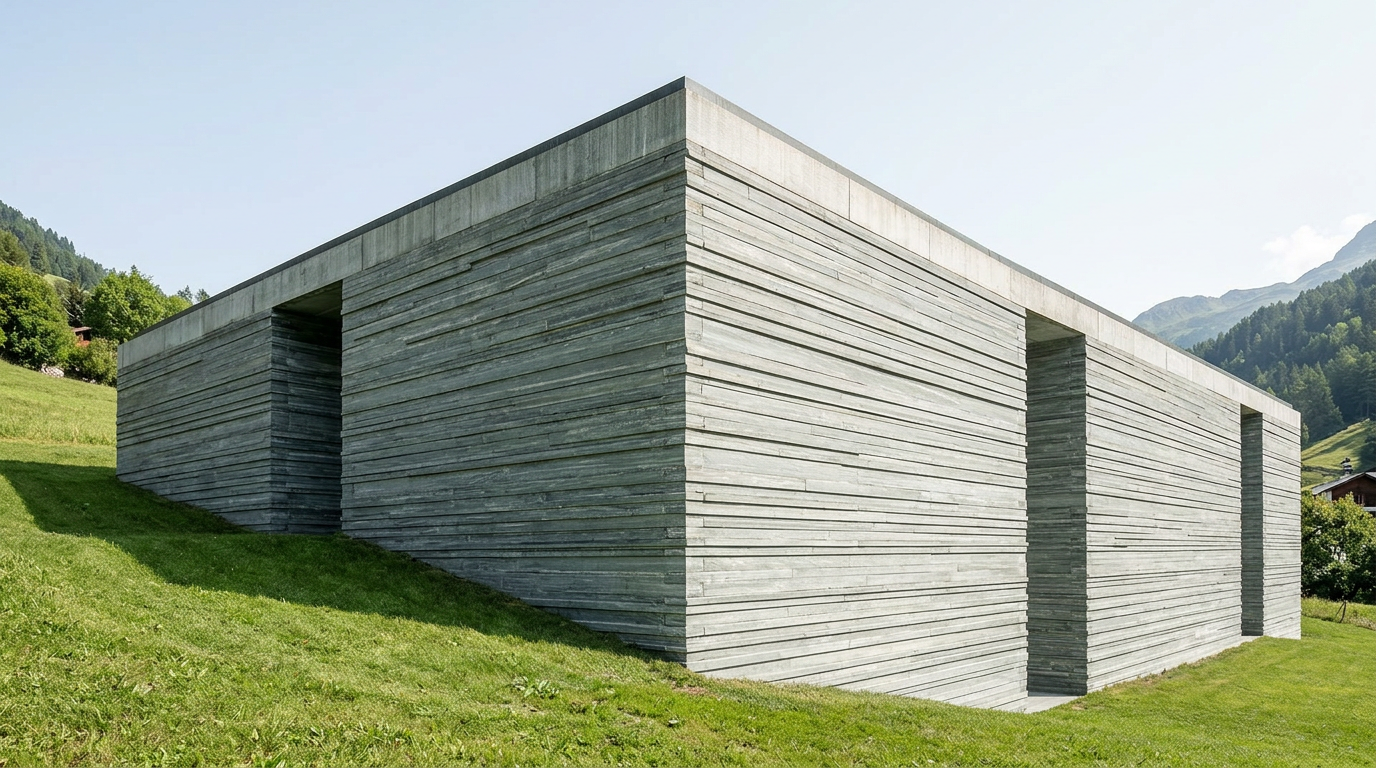
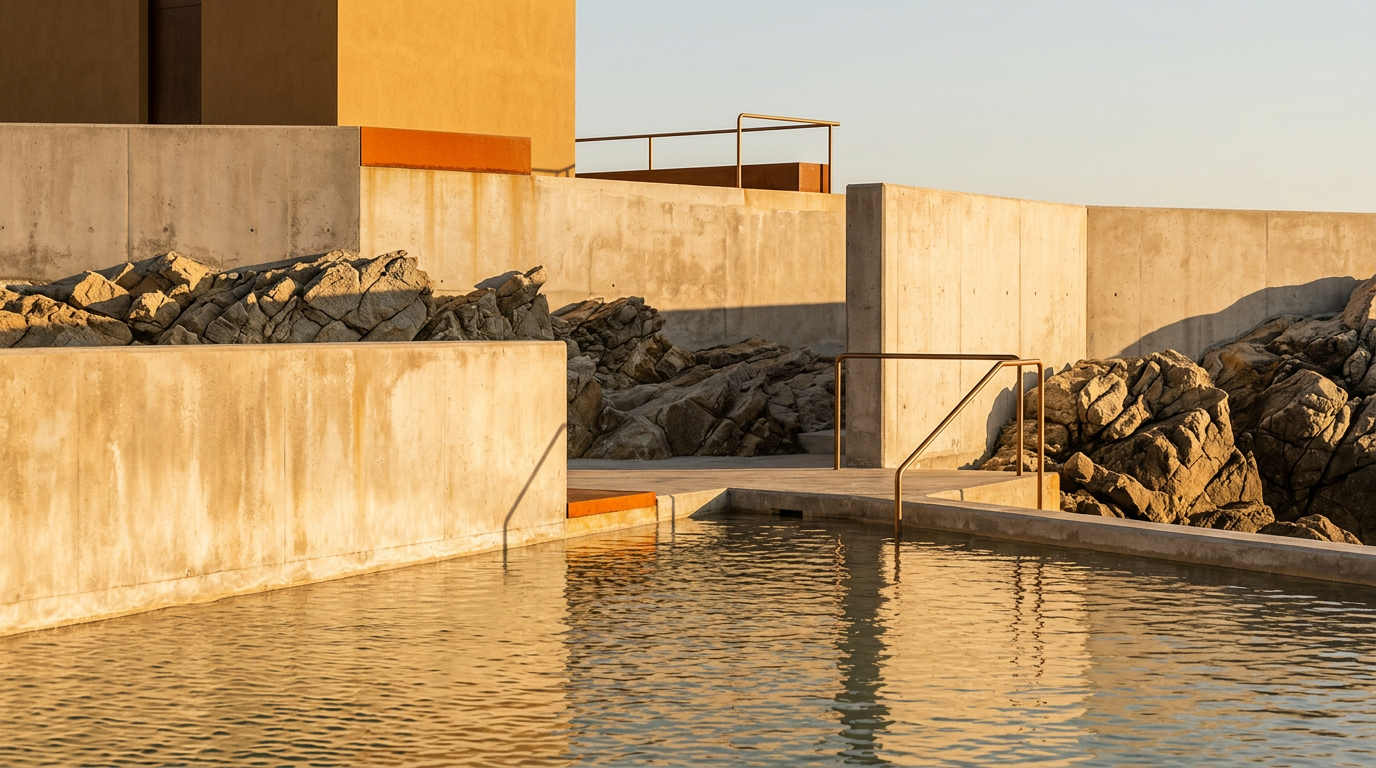
1. Stacked quartzite joints — The walls at Vals show horizontal layers of stone where the water line meets the mineral surface in a precise, dark shadow. 2. Concrete pool lip — A close-up at Leça da Palmeira reveals the weathered texture of the concrete where it transitions into the natural jagged rocks. 3. Yellow ochre facade — The exterior of Molitor displays a saturated yellow render, punctuated by the shadows of its rhythmic balconies and blue railings. 4. Steaming water surface — Looking across the interior bath at Vals, the light filters from narrow ceiling gaps, catching the rising mist against dark stone. 5. Tidal threshold — A view of the concrete stairs at Siza's pool submerged in salt water, showing the grip and wear of the Atlantic.
Peter Zumthor: The Mineral Cave at Vals
In 1996, Peter Zumthor completed the Thermal Baths Vals in the Graubünden canton of Switzerland. The project is famously constructed from 60,000 slabs of Valser quartzite, a local stone characterized by its greenish-grey hue and shimmering mica content. Zumthor’s argument for this building was one of "mountain, stone, and water." Rather than a building placed on the site, the baths feel like a quarry carved into the hillside.
The plan is organized around several large stone blocks that support a heavy concrete roof. Between these blocks, narrow gaps in the ceiling allow thin ribbons of light to penetrate the darkness, highlighting the steam. The water itself varies in temperature and mineral concentration, but the constant is the stone. The quartzite is not merely a finish; it is the structure. The slabs are laid in a technique that resembles geological strata, making the act of bathing feel like a return to a subterranean, primordial state.
Álvaro Siza: Concrete and the Atlantic Tide
On the coast of Leça da Palmeira, Portugal, Álvaro Siza designed the Piscina das Marés between 1961 and 1966. While Zumthor’s work is inward and protective, Siza’s pools are an extroverted negotiation with the ocean. The architect used raw, cast-in-place concrete to define boundaries within the existing rock formations. The Atlantic Ocean is the primary participant here; the pools fill and empty with the tide, creating a dynamic landscape that changes by the hour.
The brilliance of Siza’s landscape architecture lies in its restraint. The concrete walls do not fight the rocks; they slide between them, creating geometric basins that appear to emerge from the surf. The paths are terraced, leading the visitor from the road level down into a world of salt air and grey concrete. By using a material that mimics the tonality of the coast, Siza allows the structure to weather under the influence of salt and spray, ensuring the pools remain a permanent part of the Portuguese shoreline.
Lucien Pollet: The Urban Ocean Liner
Lucien Pollet’s Piscine Molitor, opened in 1929 in the 16th arrondissement of Paris, represents a completely different ethos. Pollet was a specialist in nautical-themed public works, and Molitor was designed to look like a luxury ocean liner moored in the city. The central outdoor pool, 50 meters in length, is surrounded by three levels of "cabines" and balconies, all rendered in a distinctive yellow ochre with blue accents.
The architecture here is theatrical. Unlike the mineral stillness of Vals or the ruggedness of Leça, Molitor was designed for the gaze. The "Catalan vault" techniques sometimes seen in contemporary European masonry are eschewed here for a rigorous Art Deco geometry. Although the building was abandoned and fell into ruin in the late 20th century, it was rebuilt behind its original listed facade and reopened in 2014. The restoration preserved the iconic "Tango" yellow walls, reminding us that bathing can also be an urban ritual of fashion and social display.
ARCHITECTT Note
The contrast between these three works reveals that water has no architectural form of its own; it inherits the character of the vessel we build for it. Whether it is the quiet quartzite of the Swiss Alps or the bold yellow decks of Paris, the material choice dictates the psychological state of the bather. When you are considering a renovation involving water, focus on how the texture of the floor meets the surface of the pool to create a seamless sensory transition. Try mapping the path from a dry threshold to a wet one in your next spatial model to see how materials should change underfoot.
Closing
The works of Zumthor, Siza, and Pollet remind us that the best bathing spaces are those that respect their specific site. In Vals, the mountain provides the stone; in Leça, the ocean provides the rhythm; in Paris, the city provides the style. Each architect understood that water is a demanding occupant that requires a clear, structural response.
These places of bathing are more than just utility; they are meditations on the elements. By studying the way light hits a quartzite wall or how a concrete ramp meets a rock, we learn that architecture is most powerful when it mediates between the human scale and the vastness of the natural world.
FAQ
Why is the stone at Therme Vals green?
The Valser quartzite used by Peter Zumthor has a natural greenish-grey tint due to its mineral composition, which becomes even more vibrant when wet, creating a deep moss-green atmosphere inside the baths.
Is the Piscina das Marés a natural pool?
It is a semi-natural pool. Álvaro Siza designed concrete walls to enclose sections of the rocky coast, but the water comes directly from the Atlantic Ocean and is refreshed by the tides.
Can you still visit the original Piscine Molitor?
The original facade and layout remain, but the interior was extensively rebuilt and restored to its 1929 appearance, now operating as a luxury hotel and club while maintaining its public swimming legacy.
What is the most important material in Zumthor’s baths?
The primary material is 60,000 slabs of quartzite, which act as both the structural skin and the aesthetic finish of the entire complex.
How did Siza handle the site's topography?
Siza used a series of ramps and terraced concrete paths to bridge the height difference between the coastal road and the rocky beach, allowing the architecture to follow the natural slope of the land.
In Short
* Peter Zumthor’s Therme Vals uses 60,000 slabs of quartzite to create a sensory, mineral-focused interior. * Álvaro Siza’s Piscina das Marés blends Brutalist concrete with the rugged Atlantic shoreline of Portugal. * Lucien Pollet’s Piscine Molitor exemplifies the 1920s ocean-liner aesthetic, recently restored behind a historic facade.
Key takeaways
- —Water dictates the choice of materials: stone for stillness, concrete for coastal resilience, and tile for urban elegance.
- —Architectural 'voids' are as important as the solids, creating the channels through which water and light move.
- —Thermal and tidal experiences require distinct structural responses to site topography.
Sources
- Peter Zumthor's 60,000 slabs of Valser quartzite laid as a cave rather than a building.https://en.wikipedia.org/wiki/Therme_Vals
- Álvaro Siza's tidal sea pools: concrete walls set between existing rocks so the Atlantic fills and empties the basins.https://en.wikipedia.org/wiki/Le%C3%A7a_Swimming_Pools
- Lucien Pollet's ocean-liner pool in yellow and blue, abandoned for two decades and rebuilt behind its listed facade.https://en.wikipedia.org/wiki/Piscine_Molitor
Topics
Continue reading