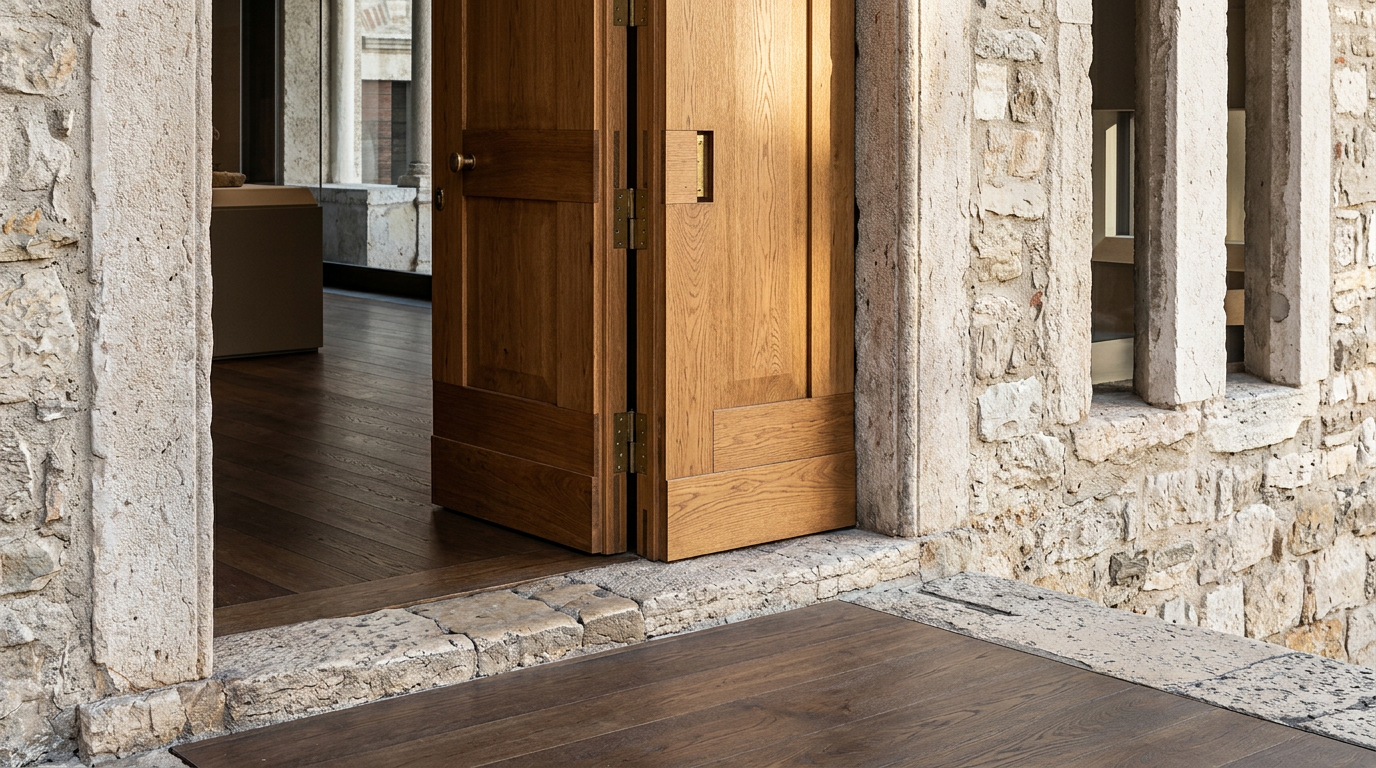

The moving frame
Visual Essay
Northern Italy: Three Adaptive Journeys Through Art and Architecture
Explore Venice, Verona, and Milan through three landmark adaptive reuse projects, from a medieval castle to an industrial distillery.
Northern Italy features several notable adaptive reuse projects that transform historical buildings into contemporary cultural spaces, including Carlo Scarpa's Castelvecchio Museum, Fondazione Prada, and Gallerie d'Italia.
Northern Italy offers a rich landscape for architectural exploration, particularly in adaptive reuse. This guide focuses on three distinct projects across Veneto and Lombardy: a medieval castle transformed by a modern master, a former distillery now housing contemporary art, and a grand palazzo revitalized for public display. Each demonstrates how existing structures can gain new life and purpose.
In Short
- Verona: Carlo Scarpa's precise interventions at Castelvecchio redefined museum design.
- Milan: Fondazione Prada repurposed an industrial complex for contemporary art.
- Venice: Gallerie d'Italia transformed a historic bank into a public art gallery.
- Each site exemplifies how adaptive reuse can respect and reimagine historical contexts.
Picture Notes
1. Limestone treads — The steps inside Castelvecchio show a worn smoothness, revealing centuries of foot traffic on the original stone, contrasted with Scarpa's new finishes. 2. Bronze elements — At Fondazione Prada, the gold leaf on the exterior of the "Haunted House" reflects light differently than the bronze cladding used elsewhere, indicating material hierarchy. 3. Palazzo facade — The neoclassical details of the Gallerie d'Italia building facade in Venice present a solid, historic presence against the canal waters. 4. Water channel — A narrow concrete channel at Castelvecchio guides water, demonstrating Scarpa's control over elemental forces within the building. 5. Stair rail — A subtly angled metal handrail at Gallerie d'Italia provides a modern counterpoint to the original stone balustrade of the palazzo stairwell.
Castelvecchio Museum, Verona
Carlo Scarpa's intervention at the Castelvecchio Museum in Verona, completed in 1975, is a pivotal work of adaptive reuse. Scarpa meticulously restored and reconfigured the medieval Scaliger castle, originally built in the 14th century, to house the city's art collection. His approach was not to erase history but to layer new details onto the existing fabric. Exposed brickwork and rough stone walls meet new concrete, polished metal, and a specific use of water. Scarpa employed water to reflect light and define spaces, notably in the moat surrounding the equestrian statue of Cangrande I della Scala.
His design for displaying art is celebrated for its precision. Sculptures are placed on custom-designed plinths, and paintings are hung within carefully articulated frames. The project exemplifies a dialogue between past and present, where modern materials and techniques enhance the historical narrative without overpowering it. The museum is a civic landmark, listed for its architectural significance. Visitors can walk through a sequence of rooms, courtyards, and circulation paths that blend original structure with Scarpa's precise modern additions. It is reachable on foot from Verona's city center.
Fondazione Prada, Milan
The Fondazione Prada in Milan, opened in 2015, transforms a former gin distillery dating back to 1910 into a permanent home for contemporary art and culture. The project, led by OMA with Rem Koolhaas, retained seven original industrial structures and added three new buildings: a cinema, a gallery pavilion, and a four-story tower. The complex covers 19,000 square meters and mixes concrete, aluminum foam, and gold leaf. The "Haunted House," a tower clad in 24-carat gold leaf, stands out as a distinct architectural gesture within the industrial setting.
OMA's design strategy embraced the site's industrial character, preserving its raw materiality while introducing refined details. The new buildings complement the old, creating a dynamic ensemble of exhibition spaces, performance areas, and public amenities. The architectural variety supports diverse artistic programs. The Fondazione is a significant cultural destination. It is accessible via public transport, with the Lodi TIBB metro station a short walk away. Booking tickets online is recommended, especially during peak exhibition periods.
Gallerie d'Italia, Venice
The Gallerie d'Italia in Venice, opened in 2022, represents the adaptive reuse of the historic Palazzo Leoni Montanari, a former bank building on the Grand Canal. This 17th-century palazzo now houses part of Intesa Sanpaolo's art collection, focusing on Venetian painting of the 18th century and antique sculpture. The intervention maintained the baroque grandeur of the original structure while updating it for contemporary museum functions.
The project involved careful restoration of the ornate interiors, including frescoes and stucco work. Modern exhibition infrastructure was integrated discreetly, allowing the art to be presented effectively within the historic context. The adaptive reuse allows public access to a building previously used for private banking, contributing to Venice's cultural offerings. This transformation underscores a commitment to public engagement with art and heritage. The museum is located in the San Polo district and is easily reachable on foot from the Rialto Bridge, offering picturesque routes through the city's calli.
ARCHITECTT Note
Adaptive reuse projects like these demonstrate the enduring value of existing structures and the ingenuity required to reimagine them for new purposes. The success lies in understanding the original character while introducing elements that speak to contemporary needs and aesthetics, often layering rather than erasing history. We can learn to appreciate the nuanced dialogue between old and new by studying how these architects managed existing fabric and introduced new materials; try to plan a section through an existing wall, showing both the original construction and a new intervention.
Closing
These three sites in Northern Italy offer more than just art; they provide lessons in architectural sensitivity and transformation. From Scarpa's deliberate layering at Castelvecchio to OMA's bold intervention at Fondazione Prada and the meticulous restoration at Gallerie d'Italia, each project invites visitors to consider the relationship between time, material, and purpose. They are examples of how historic buildings can remain vital, becoming platforms for new cultural experiences while preserving their legacy.
To experience these transformations, a logical route would begin in Verona with Castelvecchio, then proceed to Milan for Fondazione Prada, and conclude in Venice with Gallerie d'Italia. This sequence allows for an appreciation of diverse approaches to adaptive reuse across distinct historical and urban contexts.
FAQ
What is adaptive reuse in architecture?
Adaptive reuse is the process of repurposing an existing building for a use other than that for which it was originally designed. This often involves significant structural and aesthetic modifications while retaining aspects of the original structure.
Why is Castelvecchio Museum considered an important adaptive reuse project?
Carlo Scarpa's work at Castelvecchio is significant for its sensitive integration of modern design elements with a medieval castle. His approach highlighted the historical layers of the building through precise detailing and material contrasts, rather than simply restoring it.
What kind of art is displayed at Fondazione Prada?
Fondazione Prada showcases contemporary art across various mediums, alongside architecture, photography, and philosophy projects. Its exhibition program is dynamic, featuring both permanent installations and temporary shows.
Is the Gallerie d'Italia in Venice focused on specific art periods?
The Gallerie d'Italia in Venice primarily features 18th-century Venetian painting and antique sculpture from the Intesa Sanpaolo collection. The palazzo's ornate baroque interiors complement these collections.
How long should one plan for a visit to each location?
For a thorough visit, allow at least 2-3 hours for Castelvecchio and Fondazione Prada each, as they involve complex spatial sequences and extensive collections. The Gallerie d'Italia typically requires 1-2 hours, depending on one's interest in the specific art on display.
Are these locations easily accessible by public transport?
Yes, all three locations are well-connected. Castelvecchio is central in Verona. Fondazione Prada is near a metro station in Milan. Gallerie d'Italia is walkable from major Venetian landmarks like the Rialto Bridge and Accademia Bridge.
In Short
Northern Italy showcases three pivotal adaptive reuse projects: Scarpa's Castelvecchio, Fondazione Prada, and Gallerie d'Italia.
Key takeaways
- —Adaptive reuse can breathe new life into historic buildings, preserving heritage while creating contemporary cultural spaces.
- —Architects like Carlo Scarpa and OMA demonstrate diverse approaches to integrating new and old structures.
- —Northern Italy offers exceptional examples of adaptive reuse in museums and art foundations, inviting visitors to experience layered histories and innovative design.
Sources
- Carlo Scarpa's intervention at the Castelvecchio Museum in Verona, completed in 1975, is a pivotal work of adaptive reuse.https://www.archdaily.com/776077/ad-classics-castelvecchio-museum-carlo-scarpa
- Scarpa meticulously restored and reconfigured the medieval Scaliger castle, originally built in the 14th century, to house the city's art collection.https://en.wikipedia.org/wiki/Castelvecchio_Museum
- The Fondazione Prada in Milan, opened in 2015, transforms a former gin distillery dating back to 1910 into a permanent home for contemporary art and culture.https://en.wikipedia.org/wiki/Fondazione_Prada
- The complex covers 19,000 square meters and mixes concrete, aluminum foam, and gold leaf. The "Haunted House," a tower clad in 24-carat gold leaf, stands out as a distinct architectural gesture within the industrial setting.https://www.oma.com/projects/fondazione-prada
- The Gallerie d'Italia in Venice, opened in 2022, represents the adaptive reuse of the historic Palazzo Leoni Montanari, a former bank building on the Grand Canal. This 17th-century palazzo now houses part of Intesa Sanpaolo's art collection, focusing on Venetian painting of the 18th century and antique sculpture.https://www.gallerieditalia.it/en/venezia/il-palazzo/
Topics
Continue reading