
Construction Diaries
Baroque Tectonics: The New York Penthouse as Sanctuary
Ornate geometry and theatrical light in a Manhattan high-rise.
The Rose Hill Penthouse utilizes Baroque-inspired geometry, lead-came stained glass, and warm terracotta-bronze materials to bridge historic New England craftsmanship with New York high-rise living.
The luxury residential landscape of Manhattan is frequently defined by a relentless transparency, where floor-to-ceiling glass creates a seamless yet often sterile transition between the domestic interior and the urban cacophony. The Rose Hill penthouse, designed by CetraRuddy, departs from this modernist default by looking toward the Baroque traditions of New England’s historic architecture and the artisanal craft of lead-came stained glass. By prioritizing depth, shadow, and the tactile quality of "living surfaces," the project provides a blueprint for how high-rise living can foster psychological wellbeing through biophilic light modulation and material warmth.
In Short
- Modern Baroque: A high-rise penthouse that uses ornate geometry and theatrical light to redefine luxury.
- Material Warmth: Features pigmented terracotta concrete and anodized bronze for a tactile, grounded atmosphere.
- Craft Revival: Reintroduces lead-came stained glass as a tool for biophilic light modulation.
- Living Surfaces: Utilizes materials that age gracefully, fostering a sense of time and psychological comfort.
The Architecture of Dramatic Contrast
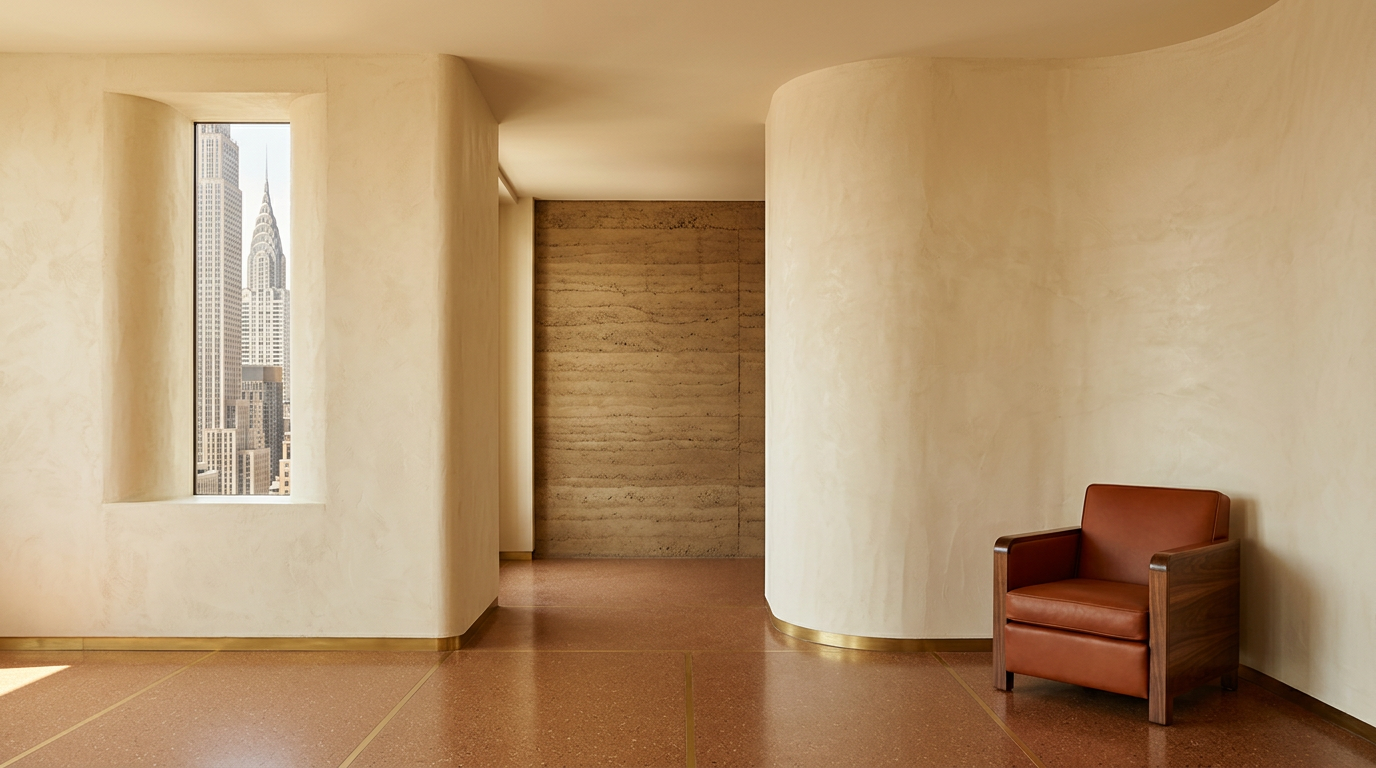
Baroque architecture is characterized by a deliberate manipulation of light and a preference for "theatrical" transitions between spaces. In the context of a New York penthouse, this manifests as a rejection of the flat, even lighting of the glass-box tower. Instead, the Rose Hill project utilizes deep-set window embrasures and faceted bronze panels to create a choreography of shadow and highlight. The facade, composed of pigmented terracotta concrete and anodized bronze, echoes the heavy masonry traditions of New England’s historic institutional buildings, yet it is executed with the precision of contemporary engineering.
This material weight is central to the occupant's sense of security. Unlike the vertigo-inducing transparency of many Midtown towers, the Rose Hill structure feels rooted. The warm-toned micro-cement floors and fired-clay rainscreen panels provide a thermal and visual density that grounds the space. During the golden hour, the low directional sun interacts with the bronze fins of the exterior, casting sharp-edged, elongated shadows that move across the oiled walnut joinery, turning the passage of time into a visible, tactile event.
Lead-Came Glass as Biophilic Filter
The inclusion of lead-came stained glass represents a significant craft-based intervention in the high-rise typology. Historically found in the ecclesiastical and collegiate architecture of the Northeast, this technique involves joining hand-blown glass fragments within H-shaped lead strips (cames). In this penthouse, the glass is not used for narrative or religious illustration but as a biological filter.
Biophilic design often focuses on the presence of plants, but the manipulation of light—specifically "non-rhythmic sensory stimuli"—is equally vital for indoor wellbeing. The lead-came windows diffuse the harsh glare of the reflection from neighboring skyscrapers, transforming raw sunlight into a softened, spectral glow. As the sun moves, the varying thicknesses and pigments of the glass create a changing pattern of color and intensity on the interior surfaces. This subtle variation mimics the flickering light found beneath a forest canopy, which has been shown to reduce cortisol levels and improve cognitive focus for residents who remain indoors for extended periods.
Living Surfaces and Occupational Wellbeing
The concept of "living surfaces" is a load-bearing theme in the penthouse’s interior logic. In a world of smudge-proof plastics and static composites, there is a psychological disconnect between the inhabitant and their environment. The materials selected for this project—unlacquered bronze, oiled walnut, and pigmented terracotta—are designed to change. They are responsive to the touch of the hand and the chemical composition of the air.
This patina is not a sign of decay but a documentation of use. The bronze hardware at the entry points will brighten where it is frequently gripped, while the walnut joinery will deepen in hue as it absorbs ambient light. This evolutionary quality of the materials fosters a sense of "place-attachment," a key component of environmental psychology. By surrounding the resident with surfaces that age alongside them, the architecture moves away from the disposable nature of modern finishes and toward a sense of enduring, domestic permanence that promotes long-term mental health and environmental comfort.
ARCHITECTT Note
There is a profound irony in the fact that the most "high-tech" solution for urban wellbeing today may be the re-adoption of 17th-century Baroque lighting and medieval glass techniques. We are seeing a shift where the luxury of transparency is being replaced by the luxury of the curated view and the protected interior. The Rose Hill penthouse suggests that the future of the New York skyline may not be found in more glass, but in the return to masonry, metal, and the hand of the craftsman.
The Vertical Sanctuary
The synthesis of traditional craft and contemporary volume in the Rose Hill penthouse marks a maturation of the high-rise residential form. It acknowledges that the ultimate goal of domestic architecture is not merely to provide a vantage point for the city, but to provide a sanctuary from it. By using lead-came glass to temper the environment and terracotta to give it weight, the architects have created a space that feels deeply connected to the regional history of New York while utilizing a modern architectural language.
Ultimately, the success of the Rose Hill project lies in its restraint. It uses the Baroque not as a style to be mimicked, but as a methodology for controlling the human experience of light and material. In doing so, it proves that the most sophisticated indoor environments are those that honor our biological need for texture, warmth, and the rhythmic movements of the natural world.
FAQ
What distinguishes "Baroque" influence in contemporary architecture?
In a modern context, Baroque influence refers to the use of high-contrast lighting (chiaroscuro), dramatic spatial sequences, and ornate, rhythmic patterns in the facade or interior detailing. It is a movement away from the flat, uniform surfaces of high-modernism.
Why is terracotta concrete being used in modern skyscrapers?
Pigmented terracotta concrete offers the durability of stone with the formal flexibility of concrete. It allows for rich, warm color palettes and textured surfaces that provide a visual "weight" and tectonic quality often missing from glass and steel towers.
How does stained glass affect the energy performance of a building?
Modern lead-came glass in high-rise applications is usually sandwiched within a high-performance insulated glass unit (IGU). This provides the thermal benefits of triple-glazing while allowing the artisanal stained glass to function as a visual and light-modulating layer.
What are the psychological benefits of "living surfaces"?
Living surfaces, which develop a patina over time, help residents feel a sense of history and permanence. This reduces the "sterility" of modern living and creates a more tactile and grounding sensory environment.
In Short
* Modern Baroque: A high-rise penthouse that uses ornate geometry and theatrical light to redefine luxury. * Material Warmth: Features pigmented terracotta concrete and anodized bronze for a tactile, grounded atmosphere. * Craft Revival: Reintroduces lead-came stained glass as a tool for biophilic light modulation. * Living Surfaces: Utilizes materials that age gracefully, fostering a sense of time and psychological comfort.
Key takeaways
- —The integration of Baroque theatricality provides a high-contrast alternative to minimalist modernism in New York residential design.
- —Lead-came stained glass is treated as a high-performance light filter that enhances indoor wellbeing by diffusing harsh urban sun.
- —A warm material palette of terracotta, bronze, and oiled walnut creates a 'living' environment that responds to human touch and time.
Sources
- The Rose Hill penthouse, designed by CetraRuddy, departs from this modernist default...https://www.archdaily.com/920404/rose-hill-residential-tower-cetraruddy
- Historically found in the ecclesiastical and collegiate architecture of the Northeast...https://en.wikipedia.org/wiki/Lead_came_glasswork
- The facade, composed of pigmented terracotta concrete and anodized bronze...https://www.dezeen.com/2021/06/28/rose-hill-skyscraper-cetraruddy-rockefeller-center-manhattan/
Topics
Referenced in this piece
Continue reading