
Stories of Place
Saline Logic: The Growth of Mineral Masonry
From Brine to Brick: The Structural Potential of Crystallized Minerals.
Architectural salt use leverages local industrial byproducts through crystallization processes to create structural masonry and cladding that is biodegradable, breathable, and deeply contextual.
The logic of masonry has historically relied on the extraction of Earth’s crust—clay, stone, and lime. However, a new paradigm of 'Saline Logic' is emerging in regions with high mineral concentrations, particularly near desalination plants and salt flats. By treating salt not as a condiment or an industrial waste product, but as a structural substrate, architects are developing a language of translucency and breathability that is chemically indistinguishable from the landscape. This approach moves beyond biomimicry into the realm of geological synthesis, where the building is literally grown from the local brine.
The Chemistry of Strength: Crystallization as Construction
The primary hurdle for salt in architecture has always been its perceived fragility. Yet, when managed through controlled crystallization, salt (Sodium Chloride) can achieve compressive strengths comparable to traditional earthen blocks. The process often involves a substrate—sometimes a recycled polymer mesh or a cellulose frame—exposed to a supersaturated brine solution. Over weeks, the salt crystals lock together, creating a dense, monolithic block.
Unlike concrete, which requires high-heat kilns and produces significant CO2, salt crystallization is an evaporative, low-energy process. In arid climates, solar energy facilitates the transition from liquid brine to solid masonry. This creates a circular loop for the desalination industry. For every liter of fresh water produced, a corresponding amount of brine is generated; redirection of this brine into architectural 'farms' allows for the production of building materials as a byproduct of water security.
Atmospheric Intelligence: The Desiccant Envelope
Beyond its structural capacity, salt possesses inherent thermodynamic and hygienic properties. It is a natural desiccant, capable of absorbing moisture from the air when humidity is high and releasing it when conditions dry out. This passive regulation creates a stabilized indoor microclimate, reducing the mechanical load on HVAC systems.
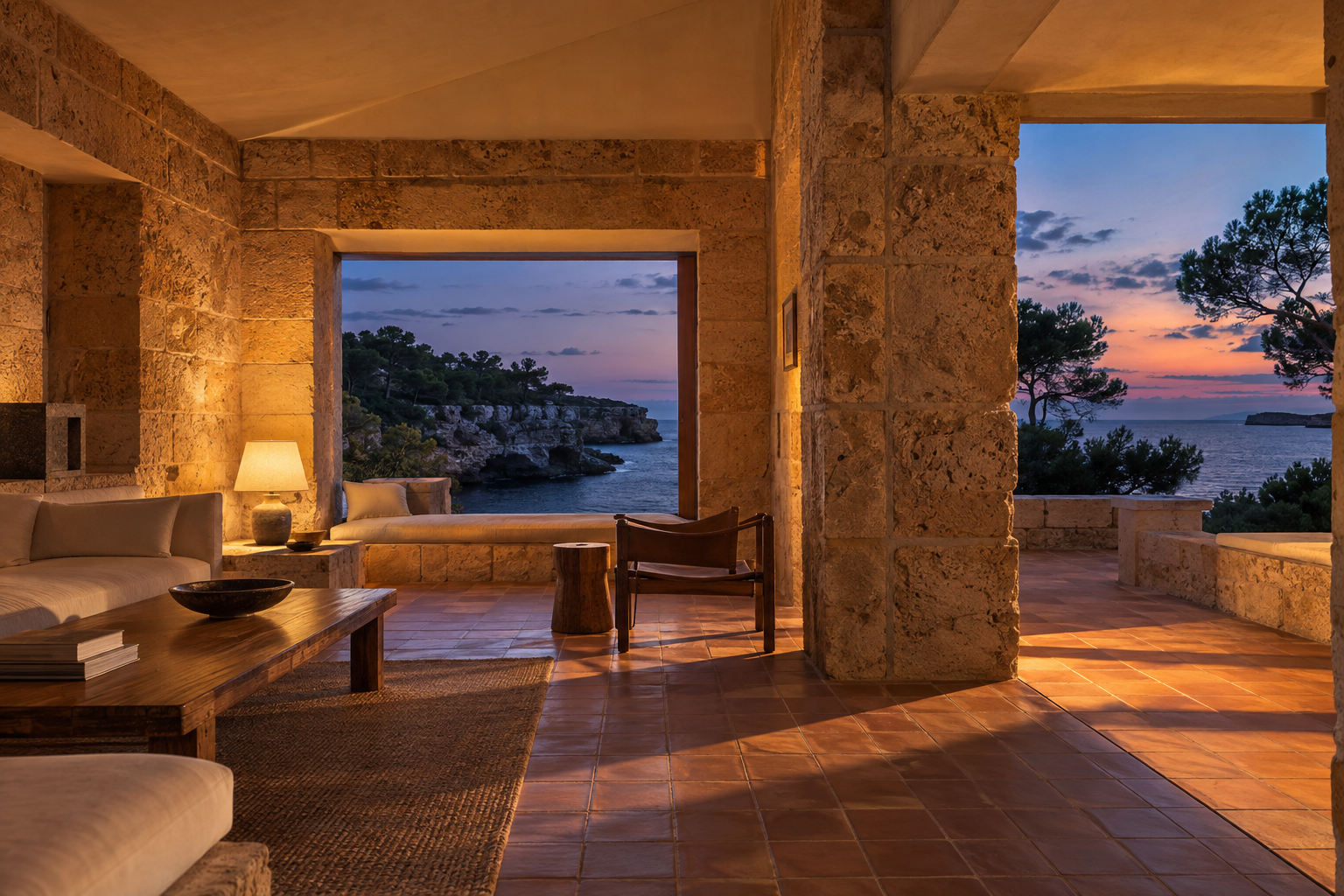
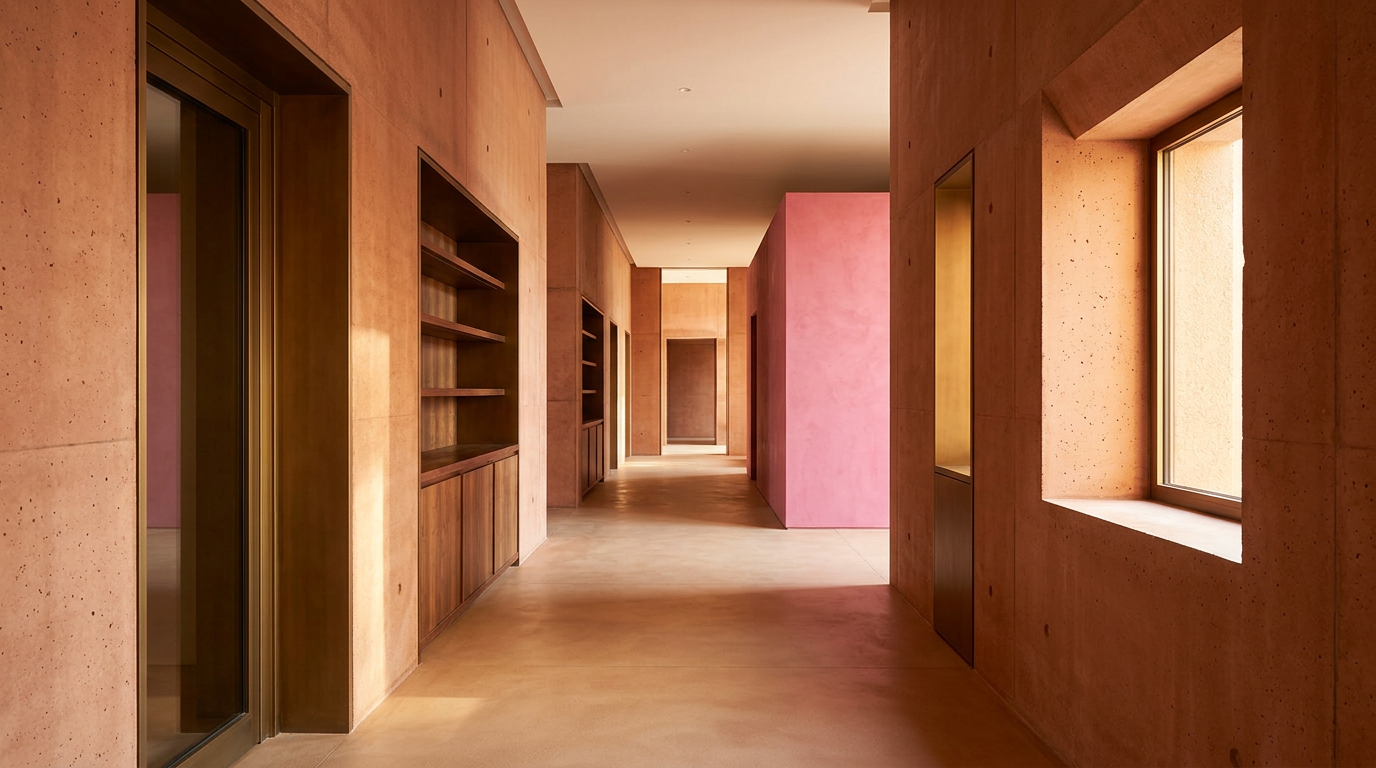
Furthermore, the translucent quality of salt bricks provides a unique light-filtering effect. In the presence of sunlight, a salt wall glows with a warm, diffused amber or white hue, depending on the mineral impurities present in the local source. This visual connection to the material's origin reinforces the 'story of place.' A building in the Dead Sea basin will possess a different chemical signature and visual density than one constructed from the byproduct of a Mediterranean desalination plant. The architecture becomes a physical record of the water chemistry of the region.
Weathering and the Solubility Paradox
The most significant critique of saline architecture is its solubility. In a rain-heavy environment, an unprotected salt wall will eventually erode. Architects are addressing this through two primary methods: tectonic shielding and bio-based sealants. Tectonic shielding involves using salt for the interior thermal mass and structural partitions while protecting it with a traditional 'raincoat' facade of glass or hydrophobic stone.
Alternatively, researchers are experimenting with bio-polymers derived from fungi or algae to coat the salt crystals, rendering them temporarily water-resistant without compromising their recyclability. The goal is not eternal permanence—a concept that has led to the current crisis of non-recyclable construction waste—but rather a 'programmed obsolescence' where the building can be safely dissolved back into the environment at the end of its functional life.
In Short
- Circular Resource: Utilizes brine waste from desalination to create structural blocks.
- Low Energy: Replaces high-heat manufacturing with atmospheric evaporation and crystallization.
- Atmospheric Quality: Naturally regulates humidity and provides high-quality diffused light.
- Biodegradable: Offers a path toward zero-waste architecture where the structure is chemically compatible with the earth.
ARCHITECTT Note
The shift toward salt is more than a material experiment; it is a rejection of the 'universal' building kit. For decades, the same steel and glass modules have been deployed from London to Dubai. Saline logic demands a return to site-specific constraints. It forces the architect to work with the chemistry of the local water and the intensity of the local sun. It is a humble architecture, one that acknowledges its own eventual dissolution, yet provides a profound sensory experience while it stands.
FAQ
Does salt architecture corrode steel reinforcements?
Yes, salt is highly corrosive to ferrous metals. Structures using salt must utilize non-corrosive reinforcements such as carbon fiber, basalt rods, or timber, or rely on pure compressive geometries like arches and vaults to minimize tension.
Is the material safe for indoor air quality?
Salt is naturally antibacterial and antifungal. High-purity salt walls are often used in 'halotherapy' environments because they can help reduce airborne pathogens and allergens, making it one of the healthiest materials for interior surfaces.
How much does it cost compared to concrete?
In regions where brine is a waste product of industry, the raw material cost is near zero. The primary cost lies in the time required for crystallization and the specialized labor needed to manage the growth process, though this is expected to decrease as laboratory-grown mineral techniques scale.
In Short
Salt-based architecture transforms a common mineral into a structural medium that is both chemically linked to its site and fully circular in its lifecycle.
Key takeaways
- —Salt architecture utilizes the waste products of desalination and mining to create structural materials.
- —The material offers unique atmospheric qualities, including natural air purification and diffused translucency.
- —Crystallization techniques allow architects to 'grow' building components rather than kiln-firing them.
- —While historically marginalized, salt is emerging as a viable solution for low-carbon construction in arid regions.
Sources
- Salt (Sodium Chloride) can achieve compressive strengths comparable to traditional earthen blocks.Research on compressed salt blocks for arid regions, e.g., studies by Eric Geboers (The Salt Project).
- Architects are developing a language of translucency and breathability that is chemically indistinguishable from the landscape.Projects like the 'Salt House' and the research of Atelier Luma on salt crystallization in Arles.
Topics
Continue reading