Future Living
Rock Hewn Dwellings: The Soundscape of Medieval Norwegian Caves
Medieval troglodyte dwellings in Norway provided not only shelter but also a unique acoustic environment shaped by their unyielding rock formations.
Medieval troglodyte dwellings in the Norwegian fjords provided shelter and a unique acoustic environment through their natural rock formations, often enhanced with split slate for interior divisions and sound management.
The medieval troglodyte dwellings carved into the fjords of Norway represent an uncommon architectural response to extreme topography and climate. These rock-hewn habitations, often augmented with meticulously split and hung slate, offered enduring shelter. Beyond their structural fortitude, these cave homes possessed a distinct auditory character, providing acoustic comfort and shaping the daily soundscape for their inhabitants. The inherent mass of the rock walls attenuated external noise, while internal geometries influenced reverberation and speech clarity.
In Short
- Medieval Norwegian troglodyte dwellings are carved into fjord-side rock.
- Slate splitting and hanging were vital craft techniques for enhancing these natural shelters.
- The massive rock walls provided significant acoustic dampening from the elements.
- The internal acoustic environment of these caves contributed to inhabitant comfort and communication.
The Landscape of Shelter: Adapting to the Fjords
During the Renaissance era, the mountainous coastlines of Norway presented formidable challenges for settlement. While timber was available, the sheer cliffs and limited flat land encouraged the adaptation of natural features. Caves, formed by glacial erosion and geological processes, offered ready-made shelters. These troglodyte dwellings were not merely natural hollows; they often involved significant human modification. Inhabitants would expand existing chambers, carve out new spaces, and refine openings. The practice offered inherent advantages: protection from harsh weather, natural insulation against temperature extremes, and defense.
These modifications often included the installation of interior partitions and the creation of more defined living areas. Evidence from archaeological sites such as the 'Kolbeinsfjellet' cave in western Norway suggests continuous occupation and adaptation over centuries. The integration of stone tools allowed for the shaping of interior surfaces, making the natural caves more habitable. These early interventions laid the groundwork for a unique architectural typology, where the natural environment was the primary structural element.
Craft and Material: Slate in the Caverns
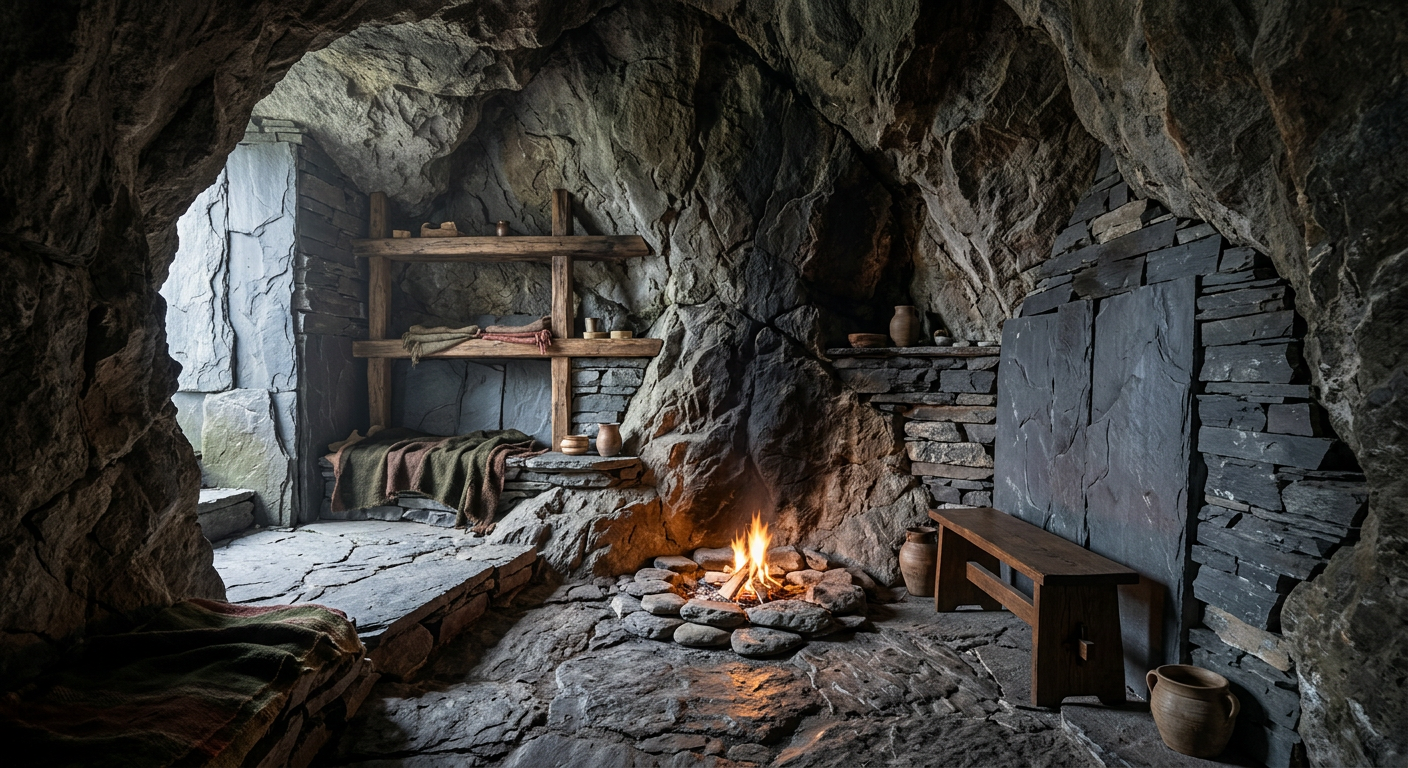
A critical craft technique in enhancing these rock-hewn dwellings was the splitting and hanging of local slate. Norwegian slate, particularly from regions like Alta in the north or Oppdal in the south, is known for its durability and laminar structure, allowing it to be split into thin, flat sheets. These sheets were not typically used for roofing in the conventional sense, as the caves themselves provided the overhead cover. Instead, slate found application in creating internal divisions, flooring, and even rudimentary furniture.
Slate panels were carefully split by hand, a process that required skill to follow the natural cleavage planes of the stone. Once split, the flat pieces could be hung or stacked to form walls, creating more private zones within the larger cave space. This technique allowed for a finer grain of architectural detail within the raw rock environment. The thermal mass of the slate also contributed to stable internal temperatures, complementing the insulating properties of the surrounding rock. Furthermore, the hard, smooth surfaces of the slate would have interacted with the cave's acoustical properties, influencing sound reflections and diffusion.
The Auditory Character of Rock: Acoustic Comfort
The most profound architectural characteristic of these troglodyte dwellings, beyond their physical shelter, was their unique acoustic performance. The massive rock walls functioned as superior sound barriers, isolating inhabitants from the roar of the wind, the crashing of waves, and the calls of wildlife outside. This offered a degree of sensory refuge, creating a distinct micro-environment of quiet.
Inside, the irregular surfaces of the natural rock formations, combined with any installed slate partitions, would have created a complex soundscape. Unlike uniformly surfaced, rectilinear rooms which can produce harsh echoes, the varying geometries within a cave might have diffused sound more effectively. Speech within these spaces would have had a specific resonance, perhaps enhanced by the reverberation off the stone. This acoustic environment likely fostered a sense of enclosure and intimacy, qualities often sought in dwelling design. The careful placement of hearths and activity zones would also impact the distribution and quality of sound, further shaping the building's auditory character.
ARCHITECTT Note
The Norwegian fjord caves highlight a fundamental architectural principle: shelter is not only about physical enclosure but also about sensory experience. The medieval inhabitants, through rudimentary yet effective interventions, tuned their environments. They understood, intuitively, the acoustic qualities of their rock-hewn homes. Their approach underscores a timeless lesson in resourcefulness and a deep reciprocal relationship between human dwelling and natural geology.
Closing
The troglodyte dwellings of the Norwegian fjords represent a singular expression of human adaptation and ingenuity. These Renaissance-era settlements, carved from the very land itself and refined with local slate, offer more than historical insights into survival. They provide a tangible link to how early cultures engaged with their environment not just for shelter, but for a holistic sense of well-being, where acoustic comfort played an integral, if unspoken, role. The resonance of these ancient spaces continues to inform our understanding of fundamental architectural principles.
FAQ
What are troglodyte dwellings?
Troglodyte dwellings are homes carved into cliffs, caves, or underground. These structures utilize natural geological formations, often with human modifications, for shelter.
Where can troglodyte dwellings be found in Norway?
While less common than in other regions, evidence of troglodyte dwellings has been found along the Norwegian fjords. Specific archaeological sites, like the 'Kolbeinsfjellet' cave, indicate human habitation.
How did medieval people create these cave homes?
Medieval inhabitants expanded existing natural caves and carved out new spaces using basic tools. They also integrated materials like slate for internal partitions and finishes.
What role did slate play in these dwellings?
Split and hung slate was used for internal walls, flooring, and other functional elements within the caves. It contributed to creating defined spaces and regulating internal temperatures.
How did the cave environment affect acoustics?
The massive rock walls provided natural sound insulation against external noise. The irregular internal surfaces likely diffused sound, creating a unique and potentially comfortable acoustic environment for the inhabitants.
How old are the Norwegian troglodyte dwellings?
While specific dating varies by site, archaeological findings suggest that some Norwegian troglodyte dwellings were occupied during the medieval and Renaissance periods.
In Short
Medieval Norwegian cave dwellings represent a unique architectural response to environmental challenges, integrating natural rock with crafted slate to create shelters with distinct acoustic properties.
Key takeaways
- —Norwegian troglodyte dwellings demonstrate ingenious adaptation to challenging environments.
- —The craft of slate splitting and hanging was crucial for interior refinement within these cave homes.
- —The natural rock formations provided exceptional acoustic insulation and shaped unique internal soundscapes.
- —These dwellings offer insights into historical approaches to thermal and acoustic comfort.
Frequently asked
What are troglodyte dwellings?+
Troglodyte dwellings are homes carved into cliffs, caves, or underground. These structures utilize natural geological formations, often with human modifications, for shelter.
Where can troglodyte dwellings be found in Norway?+
While less common than in other regions, evidence of troglodyte dwellings has been found along the Norwegian fjords. Specific archaeological sites, like the 'Kolbeinsfjellet' cave, indicate human habitation.
How did medieval people create these cave homes?+
Medieval inhabitants expanded existing natural caves and carved out new spaces using basic tools. They also integrated materials like slate for internal partitions and finishes.
What role did slate play in these dwellings?+
Split and hung slate was used for internal walls, flooring, and other functional elements within the caves. It contributed to creating defined spaces and regulating internal temperatures.
How did the cave environment affect acoustics?+
The massive rock walls provided natural sound insulation against external noise. The irregular internal surfaces likely diffused sound, creating a unique and potentially comfortable acoustic environment for the inhabitants.
How old are the Norwegian troglodyte dwellings?+
While specific dating varies by site, archaeological findings suggest that some Norwegian troglodyte dwellings were occupied during the medieval and Renaissance periods.
Sources
- The 'Kolbeinsfjellet' cave in western Norway suggests continuous occupation and adaptation over centuries.https://www.uis.no/en/news/rock-shelter-kolbeinsfjellet
- Norwegian slate, particularly from regions like Alta in the north or Oppdal in the south, is known for its durability and laminar structure.https://www.norskarkitektur.no/en/facts/norwegian-slate
Continue reading