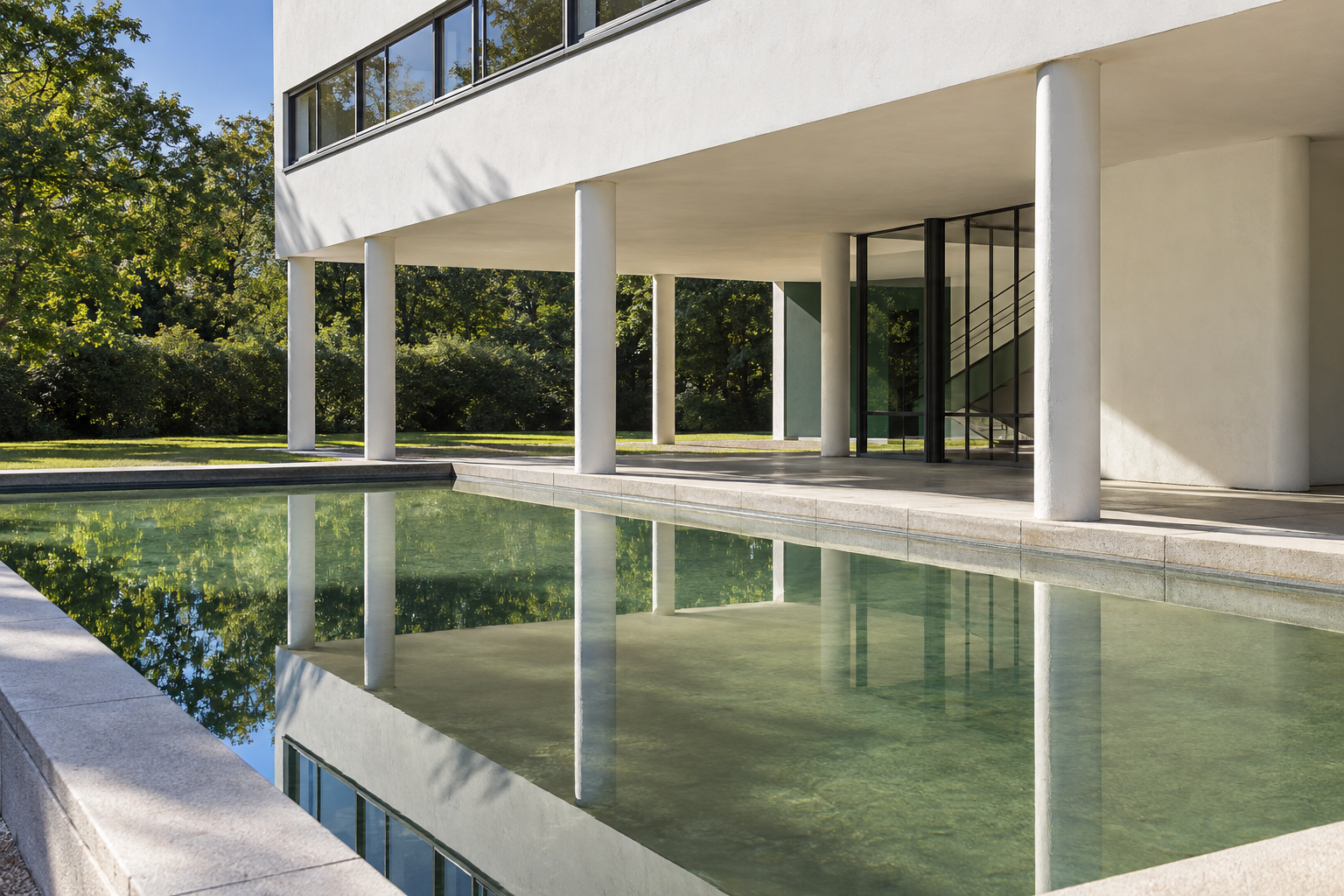

Material Notes
Hydraulic Logic: The Fluidity of Water as Structure
Water's role in architecture extends from static load-bearing elements to dynamic, responsive systems, challenging conventional material applications.
Water acts as a dynamic structural element in architecture through hydrostatic pressure for support, thermal mass for climate regulation, and fluidity for adaptive spatial systems.
Water, typically perceived as a non-structural element, serves as a dynamic and often overlooked component in architectural applications. Its properties, including incompressibility, fluidity, and heat capacity, enable its use beyond mere aesthetic or environmental control, facilitating hydrostatic support, thermal regulation, and responsive spatial definitions.
In Short
- Water provides hydrostatic support in foundations and structural systems.
- Its thermal mass contributes to passive heating and cooling in building envelopes.
- Fluid dynamics allow for adaptable and responsive architectural elements.
- Water-based systems can reduce reliance on conventional heavy structural materials.
Hydrostatic Foundations and Basements
In specific geotechnical conditions, water actively contributes to structural stability, particularly in below-grade construction. The principle of hydrostatic uplift, often a challenge, can be intentionally harnessed. Basements and underground structures in areas with high water tables can be designed with a positive hydrostatic pressure strategy. This involves creating a continuous, watertight concrete shell that allows external groundwater pressure to counteract internal loads, or to balance buoyancy forces.
Water-filled cavities or double-skin foundations can use the incompressibility of water to distribute loads. The "bath-tub" principle, where a structure acts as a sealed vessel within the water table, relies on precise engineering to manage upward buoyant forces; these forces, if properly balanced, can reduce the net downward load on a foundation. This approach is evident in projects requiring deep excavation near water bodies, where water acts as both a challenge and a potential structural ally.
Dynamic Envelopes and Thermal Mass
The thermal properties of water are leveraged in facades and roof systems. Water's high specific heat capacity allows it to absorb and release significant amounts of thermal energy. This makes it an effective medium for passive heating and cooling. Water-filled glass panels or translucent tanks integrated into facades can store solar heat during the day and radiate it indoors at night, mitigating temperature fluctuations. Conversely, in warm climates, water screens can absorb heat, reducing solar gain.
Projects such as the BIQ House (Building International Quarter) in Hamburg, Germany, utilize bioreactors within a glass facade. These contain microalgae suspended in water, which grow using sunlight and nutrients. The biomass generated is then harvested for energy, while the water itself provides thermal insulation and dynamic shading. This exemplifies water's role as an active component in regulating indoor climate and energy performance.
Tensile Structures and Fluid Forms
While water itself does not possess tensile strength in a conventional material sense, its containment defines and influences forms that behave under tension. Water-filled membranes or translucent bladders create soft, pliable architectural elements. These can serve as dynamic partitions, light diffusers, or even load-distributing cushions. The form is dictated by hydrostatic pressure and the boundary conditions of the containing membrane.
Experiments in fluid-form architecture explore how water's movement can shape and reshape spaces. Concepts for adaptive buildings include water-filled core elements that shift mass for seismic dampening or responsive facades that change transparency and insulation properties based on external conditions. This extends to large-scale interventions, where artificial wetlands or reservoirs are integrated into urban structures not just for ecological benefit, but also for their capacity to absorb and release energy, and to define spatial sequences through their fluid boundaries.
ARCHITECTT Note
Hydraulic logic provides a counterpoint to traditional material-centric structural thinking. It proposes that transient and malleable states of matter can contribute to architectural permanence and performance. The challenge lies in engineering containment and controlling fluid dynamics to ensure reliability and longevity, moving beyond the static to embrace dynamic equilibrium.
Closing
The integration of water into architectural structure and envelope systems redefines material potential. It moves beyond the inert qualities of solid matter, presenting water as an active contributor to thermal regulation, structural stability, and spatial adaptability. Future exploration will likely focus on advanced fluid containment, kinetic water systems, and the further harnessing of its thermodynamic properties to create responsive and materially efficient buildings.
FAQ
Can water genuinely act as a structural element?
Yes, water can act as a structural element, primarily through hydrostatic pressure. In foundations, it can balance buoyant forces or distribute loads. In dynamic systems, water's incompressibility is manipulated to create support or transfer forces, often within a containing membrane.
What are water's key properties for architectural application?
Water's key properties for architectural applications include its incompressibility, high specific heat capacity, and fluidity. These enable hydrostatic load distribution, thermal mass for energy regulation, and dynamic responses for adaptable building systems.
How is water used in building envelopes for thermal control?
Water is used in building envelopes as thermal mass. Water-filled panels or cavities absorb and store solar heat, releasing it when temperatures drop, or dissipating heat in warm conditions. This helps to passively regulate internal temperatures and reduce energy consumption.
What is the BIQ House in Hamburg known for?
The BIQ House in Hamburg is notable for its bio-adaptive facade. It integrates bioreactors containing microalgae suspended in a water medium. This system generates biomass for energy, provides dynamic shading, and contributes to the building's thermal insulation.
Are there examples of water being used in tensile structures?
While water itself is not a tensile material, it can fill tensile membranes or bladders to create fluid forms. These contained water elements can act as dynamic partitions, light diffusers, or shock absorbers, with their shape determined by hydrostatic pressure and membrane boundaries.
What challenges exist in using water as a structural material?
Challenges include ensuring water containment and preventing leaks, managing corrosion in associated materials, mitigating freezing in cold climates, and precisely engineering fluid dynamics for reliable structural performance over time. Maintenance and long-term integrity are also considerations.
In Short
Water's material properties, including incompressibility and high specific heat, reposition it as a dynamic, structural component in architecture.
Key takeaways
- —Water provides hydrostatic support in building foundations.
- —Water's thermal mass is effective for passive climate control.
- —Fluid dynamics enable responsive architectural elements.
- —Challenges include containment, freezing, and long-term material integrity.
Sources
- Projects such as the BIQ House (Building International Quarter) in Hamburg, Germany, utilize bioreactors within a glass facade.https://www.solaripedia.com/files/14022
- These contain microalgae suspended in water, which grow using sunlight and nutrients. The biomass generated is then harvested for energy, while the water itself provides thermal insulation and dynamic shading.https://www.arup.com/projects/biq-house
Topics
Continue reading